

What if you could reverse years of muscle weakness and stiffness with just a few simple TRX moves?
I’ve helped hundreds of seniors rebuild their muscle, strength and mobility right from home, with nothing but a suspension trainer.
And the best part?
The straps support you the whole way, so you can rebuild your strength safely, at your own pace.
So in this post, I’m going to show you:
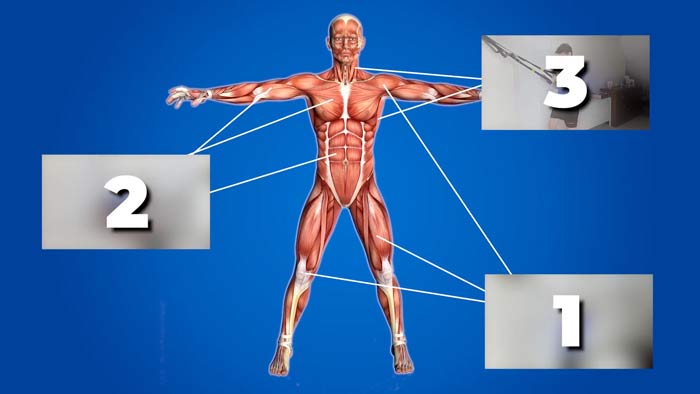
- The 3 TRX moves that target the exact muscle weaknesses that age you fastest
- Why most people do them wrong
- 6 more TRX exercises to progress onto, for complete strength, balance and mobility
Start with the 3 foundation TRX exercises below, then progress to 6 more, and follow the free workout plan at the end.
Want these exercises laid out for you, week by week?
Grab my free 4-week workout plan below, and you’ll know exactly what to do each session.
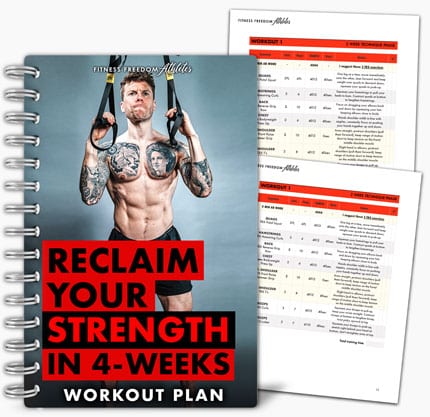
Free Reclaim Your Strength in 4-Weeks (Suspension Trainer Plan)
Gain better movement, confidence, and mobility in 8 neglected and essential strength areas. Just tell me where to send it…
Don’t have time to read the post in full? Then watch the video below to learn the essential TRX exercises to rebuild strength and mobility:
The Ageing Effect You Can’t See
I’ll never forget David, a 63-year-old consultant who was fit in college, played rugby, and felt invincible.
But now?
He couldn’t lift his 5-year-old granddaughter without his back seizing up.
Climbing two flights of stairs left him winded.
He said, “Adam, I feel like I’m 90 years old.”
Here’s what he didn’t realise:
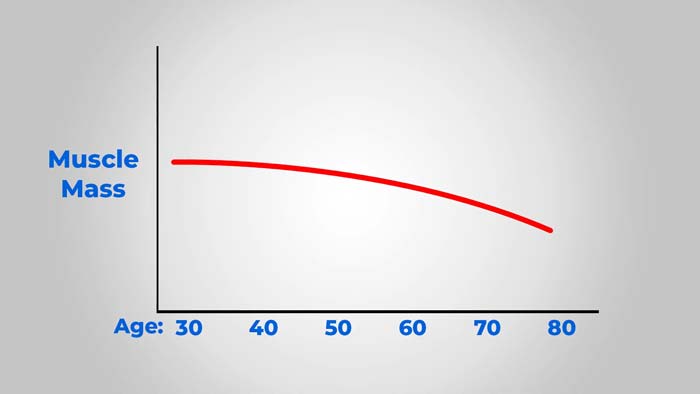
Every 10 years after 30, you lose 3-8% of your muscle mass.
And that loss speeds up after 60, which is why everyday things like getting up from a chair, carrying shopping or climbing stairs start to feel harder.
But it’s not just about size, it’s about quality.
Weak, poorly-functioning muscle:
- Can’t regulate your hormones like testosterone and estrogen
- Can’t protect your joints
- Can’t even keep your brain sharp…
Research shows having quality muscle mass reduces dementia risk by 72%.
Between work and grabd kids David had zero time.
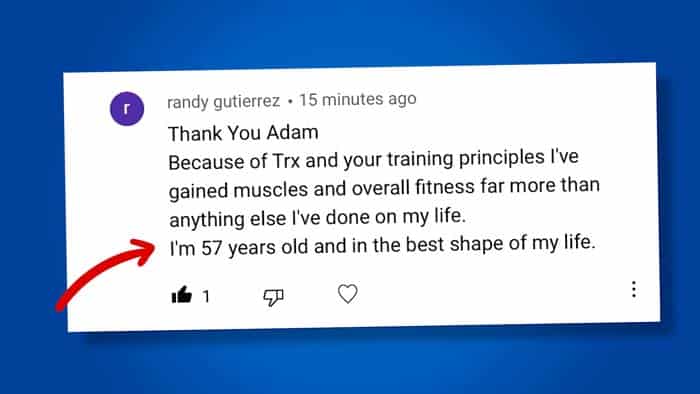
So I taught him these 3 foundational TRX moves to do at home first, 3 times a week. 4 weeks later, he sent me this:

Why These TRX Moves Are So Effective
They don’t promise you a Greek god body.
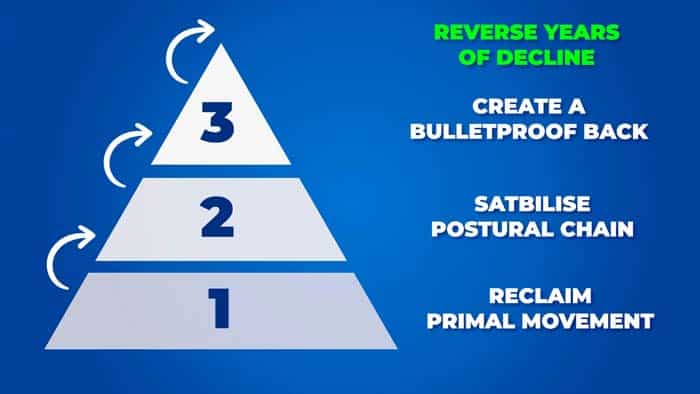
Instead, each one targets the exact muscle weaknesses that age you fastest, building both strength and mobility in the areas you use every single day.
With each move building on the last to systematically reverse years of decline.
All in one flowing sequence
And because the straps support your bodyweight, you control exactly how hard each exercise is.
That makes TRX one of the safest ways to rebuild strength at any age…
You’ll also notice there are no push-ups or presses in this plan. That’s deliberate.
Most of us are already push-dominant from daily life:
- pushing doors, trolleys and ourselves up from chairs
- plus years of push-ups and presses.
What’s usually weak is the back of the body, your posture and your pulling strength.
So that’s exactly what these exercises focus on.
So to start, let’s fix the number one primal movement pattern you’ve lost…
Start Here: The 3 Foundation Exercises
1: Unlock Primal Mobility: TRX Overhead Squat
The overhead squat is your foundation.
Skip this and you’ll stay trapped in the decline cycle.

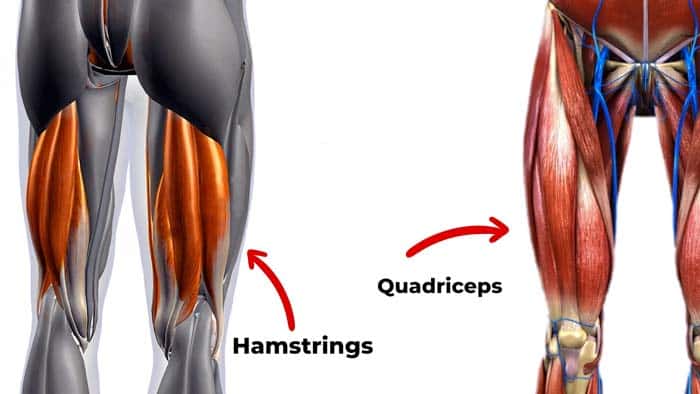
But master it and you strengthen your hamstrings and quads…
While firing up your rear shoulders to fix your posture, undoing years of desk damage in a single exercise.
But here’s the mistake that makes this exercise useless…
Most people just drop down fast with limp arms.
But you’ve got to pull yourself down and resist gravity.
Here’s how to do it:
- Stance just outside shoulder width, toes slightly out.
- Here’s the game-changer: Imagine crushing a stability ball between your heels and butt as you descend. You’re loading tension into your hamstrings instead of just dropping with gravity.
- Go down over 2 seconds as deep as you can (halfway is fine for now). You’ll get lower over time.
- Pause, then drive through your heels to rise back up over 2 seconds, keeping that squeeze.
Most people are quad-dominant with dead hamstrings.
That’s why you get knee pain.
By focusing on engaging the hamstrings throughout the movement, you’ll build balanced muscle in the legs and reduce knee pain.
And don’t forget this
Keep your arms slightly bent, with your shoulder blades back, then push your hands back into the straps…

You should feel the back of your shoulder muscles firing.
Super important to strengthen because they reverse rounded shoulders and stabilise your whole shoulder joint for all arm movements.
If your arms get tired before you complete the set, that’s ok…
Just lower them down in front of you and continue the squats.
Keep a slight bend in the knee at the top to ensure tension remains on the hamstrings.
Do 3 sets of 8-15 reps
And you’ll be sending me messages like…
Next, let me show you the move that gets you walking with power again…
2: Walk With Power: TRX Mountain Climbers
Your hip flexors lift your legs every time you walk, climb stairs or step over something.
When they’re weak, every step feels heavier, and your lower back has to compensate.
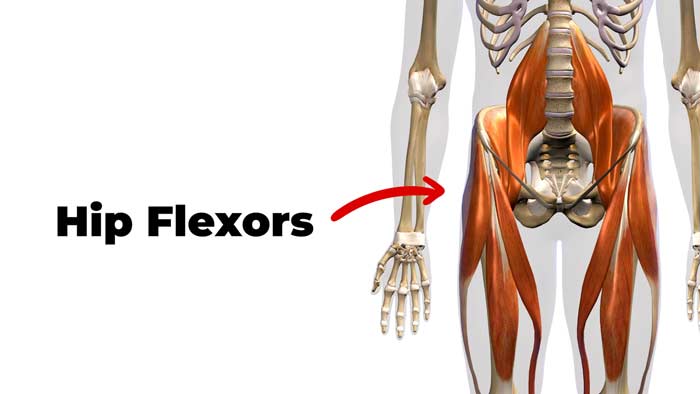
Strong hip flexors also help you lift your feet properly, which reduces trips and falls.
Mountain climbers strengthen them, and the standing version lets you hold the straps for balance the whole time…

- Set your straps to a long length, and hold them under your armpits, facing away from the anchor, feet together.
- Pull your belly button in towards your spine to switch your core on.
- Drive one knee up and across towards the opposite side: 1 second up, a 2-second squeeze at the top, 1 second down.
- Keep your head up, then switch sides.
Sets and reps: 3 sets of 10–15 reps on each side.
Level up: once you can do 15 controlled reps each side, hold your hands out in front of you, like a chest press, and take a small step back. Your core has to brace harder…

Level up again: get your feet in the straps and into a push-up position. Squeeze your abs and bring your right knee to your left elbow, hold for 2 seconds, then lower slowly and switch sides. Aim for 6–10 clean reps each side…

Next, let me show you the one weakness that’s secretly sabotaging everything else you do…
And how to fix it with TRX exercise number 3…
3: Bulletproof Back: TRX Reverse Grip Rows
Humour me, can you comfortably pull yourself up on a horizontal bar?
No?
That’s because we spend our lives pushing: doors, shopping carts, lawn mowers….
But rarely pulling.
This means your latissimus dorsi muscles, the big foundation muscles that runs down the sides of your back, go weak.
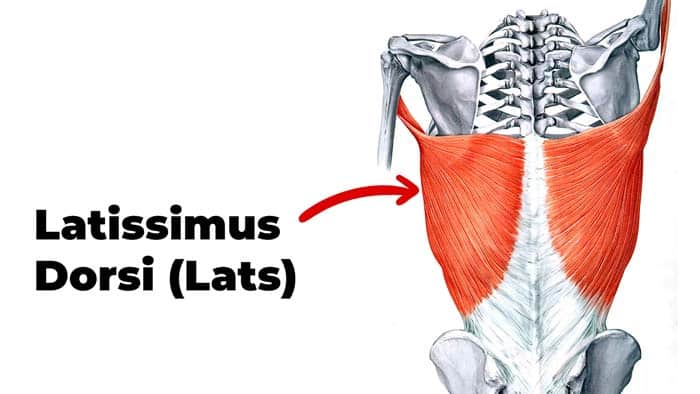
These are the muscles you use every time you pull furniture or attempt any pull-up related movement.
Reverse grip rows target and strengthen them.
But here’s the mistake most people make…
They rush through the exercise using momentum and never fully squeeze or stretch the muscle.
Meaning they miss out on complete muscle activation.
So, let’s fix that…
- Start at the top, elbows back, chest out, lats tight.
- Slight lean, shoulder-width stance.
- Squeeze your lats by driving elbows back and down against the straps.
- Lower slowly over two seconds and push your arms forward at the bottom to stretch your lats. Don’t just hang there.
- Pull up over 2 seconds by driving elbows down and back alongside your body and squezze for 2 at the top
Aim for a high rep range of 10 – 15 reps over 3 sets.
Why this hand position?…

Well it mimics real life pulling for furniture and carrying heavy objects…
And it allows you drive your elbows back deeper for a greater muscle activation.
These 3 exercises will rebuild your foundation….
But once you master them, your body will adapt…
Stop progressing and you’ll plateau. Or worse, decline again.
So when the 3 foundation moves feel comfortable, it’s time to progress.
Ready for More? Progress With These 6 Exercises
These 6 exercises target the rest of the muscles you rely on every day: your legs, glutes, posture, core and grip.
Add them in once the foundation moves feel comfortable, and take each one at your own pace.
A quick safety note:
Start with a small angle and a small range of motion. Hold the straps for balance whenever you need to. And if you have a health condition or injury, check with your GP or physio before you start…
4. Stand Up With Ease: TRX Reverse Lunge
This builds on the overhead squat by training one leg at a time.
Ever noticed how getting up from the sofa or the floor feels harder than it used to?
The problem isn’t age. It’s your quadriceps, the powerhouse muscles at the front of your thighs.
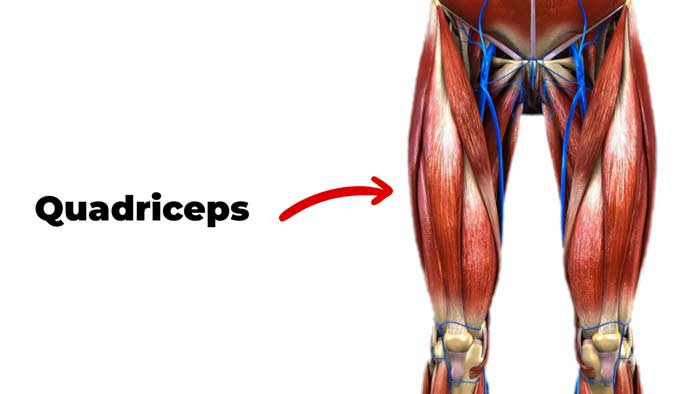
They straighten your knees, lift your legs when you climb stairs, and keep your kneecaps steady.
When you spend hours sitting, they lose their power.
So how do you break this cycle and strengthen these hydraulic muscles?
Let me show you…
- Hold the straps, and place one foot directly in line with the anchor.
- Keep your torso slightly bent forward to load your quads.
- Lunge back slowly over 2 seconds, and lightly touch the ground with your back knee. Only go as low as feels comfortable.
- Return up over 2 seconds, then squeeze your quads hard at the top for 2 seconds.
Sets and reps: 3 sets of 8–12 reps on each leg.
5. Awaken Your Power Engine: TRX Glute Bridge
Your glutes are the power engine of your body.
They support your posture, power your legs and keep your hips stable, which is essential for balance.

But hours of sitting switch them off, so your lower back and hamstrings overwork instead.
Here’s how to strengthen them…
- Get both feet in the straps, lie on your back, and lift your bum an inch off the ground. This is your starting position.
- Squeeze your glutes hard before you move.
- Drive your hips up, and hold for 2 seconds.
- Lower slowly.
Sets and reps: 3 sets of 8–12 reps.
6. Stand Tall Again: TRX Face Pulls
This builds on the rear shoulder work from the overhead squat.
Ever been told to stand up straighter, but your shoulders feel locked in place?
Your chest muscles have tightened up and are winning a tug-of-war against your weak rear shoulders, pulling you into a hunch…
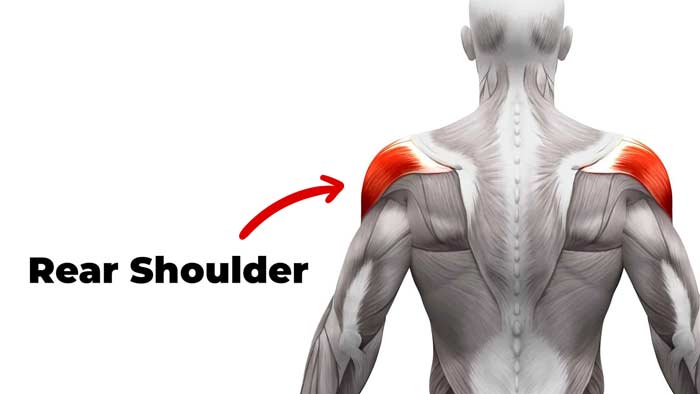
Face pulls strengthen your rear shoulders to pull you back upright.
Here’s how to do them:
- Grab the straps, and raise your hands so they’re in line with your nose.
- Squeeze your shoulders by pulling the straps hard.
- Lower slowly over 2 seconds, stopping before your arms straighten.
- Return up, rotate your knuckles upward, and squeeze your rear shoulders extra hard at the top.
Sets and reps: 3 sets of 10–15 reps.
7. Protect Your Spine: TRX Superman (Back Extension)
This builds on the core strength from the standing mountain climbers.
Your erector spinae run up your spine like the ropes holding a sailing mast upright…

They keep you upright when you walk or stand, and help you lift things safely.
Strengthen them, and lifting the grandkids, the shopping or a suitcase stops feeling risky.
Here’s how to strengthen them:
- Get the straps over your shoulders, and take a wide stance.
- Squeeze your core, and extend your arms until your body is straight.
- Hold for 5 seconds, feeling your middle back engage.
- Squeeze your abs hard to curl back in.
If you find these hard, stand more upright to reduce the angle.
Sets and reps: 2 sets of 3–6 reps.
8. Twist and Bend Safely: TRX Side Bends
Your obliques are the shock absorbers at the sides of your core.
They let you twist and bend safely, whether that’s reaching into the car, gardening or swinging a golf club…
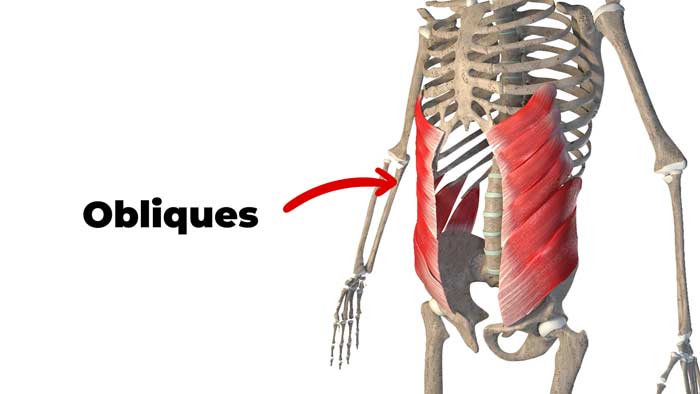
When they’re weak, you’re at risk of side strains and lower back pain.
Here’s how to strengthen them:
- Grab the straps, and get them above your head.
- Take a slight step inwards.
- Extend your body out until you feel a stretch down your side.
- Squeeze your core to rise back up, and squeeze again at the top.
Sets and reps: 2 sets of 8–12 reps on each side.
9. Strengthen Your Grip: TRX Reverse Curls
Grip strength is one of the best signs of strength as we age.
You need it for opening jars, carrying shopping and holding the handrail.
Reverse curls strengthen the brachioradialis…

The grip engine in your forearm, which also protects your wrists and elbows.
Here’s how to do them:
- Get an overhand grip on the handles, and lean back slightly.
- Squeeze your forearms and biceps at the top.
- Lower slowly over 2 seconds, keeping a slight bend at the bottom.
- Return up, squeezing your forearms, and rotate your thumbs up for an extra squeeze at the top.
Sets and reps: 2 sets of 8–12 reps.
Your Free TRX Workout Plan for Seniors
Here’s how to put all 9 exercises together…
Train 3 days a week (for example, Monday, Wednesday and Friday), with a rest day in between…
Phase 1: Weeks 1–4 (Foundation)
Do the 3 foundation exercises each session:
- Overhead Squat: 3 sets of 8–15 reps
- Standing Mountain Climbers: 3 sets of 10–15 reps each side
- Reverse Grip Row: 3 sets of 10–15 reps
Rest 60–90 seconds between sets….
Phase 2: Weeks 5–8 (Progression)
Alternate between two workouts, so you train all 9 exercises without long sessions:
Workout A: Overhead Squat, Reverse Lunge, Reverse Grip Row, Face Pulls, Reverse Curls
Workout B: Glute Bridge, Standing Mountain Climbers (or your level-up), Superman, Side Bends
Use the sets and reps listed with each exercise, and rest 60–90 seconds between sets.
How to progress:
- Once you can do the top of the rep range with good technique, make it slightly harder.
- Take a small step to increase your angle, or slow down the lowering phase. If your form slips, step back again.
Want it all laid out for you?
Grab the free 4-week plan below, and you’ll know exactly what to do in every session…
Free Reclaim Your Strength in 4-Weeks (Suspension Trainer Plan)
Gain better movement, confidence, and mobility in 8 neglected and essential strength areas. Just tell me where to send it…
TRX for Seniors FAQ
Is TRX good for seniors?
Yes, it’s one of the best ways to rebuild strength as you get older. The straps support your bodyweight, so you control exactly how hard each exercise is, just by changing your angle. That means you can start gently and build up safely, while strengthening the muscles you rely on every day.
Is TRX safe for people over 70?
For most people, yes, as long as you start gently. Begin with a small angle, hold the straps for balance, and move slowly with control. If you have a health condition, joint problem or recent injury, check with your GP or physio before starting, and stop any exercise that causes pain.
How often should seniors do TRX?
3 times a week is ideal, with a rest day in between each session. That gives your muscles time to recover and get stronger. Short, consistent sessions are far better than long, occasional ones.
Can TRX help with balance?
Yes. Because the straps move slightly, your body has to keep itself steady, which trains the small stabilising muscles in your legs, hips and core. Exercises like the reverse lunge and standing mountain climbers are especially good for balance, and you can hold the straps for support while you build confidence.
Do seniors need experience to start TRX?
No. The 3 foundation exercises in this post are designed for complete beginners. Start with a small angle, focus on slow, controlled technique, and only progress once you feel comfortable.
More TRX Guides
- Want to build your own plan? See how to create a TRX workout plan.
- For the complete exercise list, see my 16 best TRX exercises.
- Wondering if TRX really builds muscle? Here’s the exact method I use.
More TRX Guides by Body Part
- TRX Chest Exercises
- TRX Arm Exercises
- TRX Core Exercises
- TRX Back Exercises
- TRX Leg Exercises
- TRX Shoulder Exercises
Here’s to your Fitness Freedom!
Coach Adam, aka TRX Traveller

0 Comments