

Here’s how I completely rebuilt my shoulders in my thirties using a TRX and without ever setting foot in a gym again…
Years of heavy ego-lifting in my 20s left me with nothing but shoulder pain.

Until I switched to slow, controlled movements using just a suspension trainer at home

So in this post, I’m going to show you how to build stronger, more defined, injury-resistant shoulders with this minimalist setup…
Using 4 TRX exercises that hit every part of your shoulder.
To start, let me show you which shoulder muscles are the most important for strength, and which for definition…
For the complete TRX exercise list, see my 16 best TRX exercises post
Don’t have time to read the post in full? Then watch the video below to learn how to build shoulders with a TRX…
Which Muscles Build Strong and Defined Shoulders?
Your shoulders aren’t one muscle. They’re three:
- Front delt: builds the shelf at the top of your chest
- Side (middle) delt: creates the cap and gives you width
- Rear delt: adds depth from the side and behind, and pulls your shoulders back for good posture
Here’s what most people don’t realise…
What makes shoulders look wide isn’t every part of the shoulder. It’s mainly one: your side delt…

But most people’s training completely ignores it.
Think about what you’ve done over the years: push-ups, bench press, overhead pressing. All of them hammer your front delts.
Do that long enough and your shoulders become overdeveloped at the front, but lack the width that truly makes them stand out.
Which is exactly what happened to me…

And on top of that, years at a desk create a tug of war across your shoulders….
Your chest, tight from years of reaching forward, wins, dragging your shoulders forward into that rounded look.
The only muscle that can win that tug of war back is your rear delt.
So the 4 exercises in this post hit all three heads, with an extra focus on the two most people neglect: the side and rear delts.
4D Shoulder Muscle Activation
Like most guys in their 20s, I thought bigger weights meant bigger shoulders.
I chased ego-lifting heavy barbells until shoulder impingement left me wincing just putting on a t-shirt.
The problem wasn’t the weights themselves. It was that I was only training about 30% of my shoulder’s full range of motion.
When I swapped heavy lifts for minimalist suspension training focused on muscle tension rather than weight…

- My shoulder pain vanished
- My posture dramatically improved
- I felt genuinely strong for family life and longevity, not just gym strong for ego
Sounds too good to be true, right?
Well, let me show you exactly how I did it.
Here are the 4 suspension exercises and the specific muscle-centric technique that bulletproofed my shoulders.
TRX Shoulder Exercise 1 – Y Shape
First up is the Y raise, targeting your side delt, the muscle most responsible for shoulder width. Your rear delts and upper traps assist, but the side delt does the heavy lifting.

But not all Y raises are created equal…
The way most people do them actually pulls tension away from the side delt. It comes down to where your arms travel.
On a suspension trainer, it’s very easy to let your upper back take over. Pull your arms too far back, or too fast, and your traps and rhomboids dominate, shifting the tension away from your shoulders entirely.

Go too far forward, and you’ll hang loosely through the joint and lose tension the other way.
Lose tension, lose growth.
Normally, I’m an advocate of using the biggest range of motion possible.
But here, the sweet spot is keeping your shoulders centred and using a short range of motion.
I tell my clients to think like a zombie….

Your hands are just hooks on the straps. It’s your shoulders driving the movement up and down, keeping that burn building in the side delt.
Here’s exactly how you do it:
- Start by raising your arms into a “Y” shape, elbows slightly bent.
- Take a small step backwards—nothing dramatic, form beats ego here.
- Slowly lower yourself for 2 seconds, stopping just before your shoulders lose tension at the bottom.
- Drive your arms up slowly by squeezing your shoulder muscles, taking another 2 seconds,
- At the top, pause and squeeze your shoulders as hard as you can for 2 full seconds, pulling against the anchor for extra tension.
Each rep should take 6 seconds.
Now let’s move onto the second exercise variation to really make your shoulders pop…
Get Your FREE Copy Of My ‘7 Skills To Build Muscle With A Suspension Trainer Handbook!’
Downloaded 70,000+ times! Just tell me where to send it:
TRX Shoulder Exercise 2 – T Shape
Shoulder width isn’t just about what people see from the front. It’s also about what they see from the side and behind.
That’s where the T raise comes in, and why it’s such a smart pairing with the Y raise.
As your arms begin to rise and move out to the sides, you’re still recruiting your side delt.

But as your arms come in line with your shoulders, the emphasis shifts and your rear delt becomes the main muscle being challenged…
That’s the part of the shoulder that’s almost always underdeveloped.

And if you spend long hours at a desk, it’s one of the most functional muscles you can build.
Strong rear delts pull your shoulders back and stabilise the joint for everyday lifting, which means better posture and fewer injuries.

Use the exact same 6-second technique as the Y raise.
The only difference is arm position: arms parallel to the floor, elbows slightly bent…
The watch-out: it’s even easier to let your upper back take over with T’s if you pull too far back.
So keep the same short range of motion and your shoulders centred.
Now here’s how to take your rear shoulder muscle development, and posture, to the next level…
TRX Shoulder Exercise 3 – Face Pulls
The T raise starts building your rear delts. Face pulls take them further.
Remember that tug of war across your shoulders?
Face pulls are one of the strongest moves to win it back.
They strengthen your rear delts and the small muscles that rotate your shoulders, pulling them open so the rounded look disappears.

They’re a little trickier to learn than T raises, which is why I teach T’s first.
But once you’ve got the hang of them, they give that popping 4D shoulder look and dramatically improve your posture.
- Grab the handles with an overhand grip and lean back at a slight angle.
- Pull the handles toward your face, aiming at nose level, over 2 seconds.
- At the top, rotate your knuckles up and squeeze your shoulder blades together.
- Hold that squeeze for 2 seconds, then lower slowly over 2 seconds.
- BUT don’t relax or hang at the bottom. You’ll lose the tension that gets results.
Face pulls are one of the 3 exercises in my posture fix routine….
If rounded shoulders and a hunched back are your main problem, see my 3 TRX Exercises to Fix Bad Posture (Video Guide + Workout Plan). It includes the other two exercises and a free 4-week posture plan.
Now let’s tackle your front delts with the suspension trainer shoulder press…
TRX Shoulder Exercise 4 – Shoulder Press
This exercise requires a different technique. But before we get to that, you might be thinking…
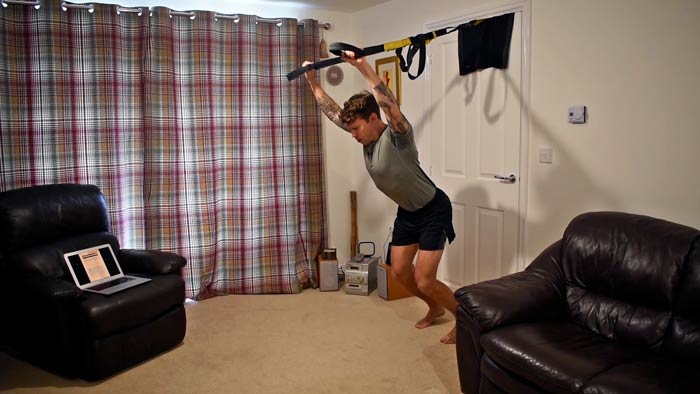
“There’s no weight here, this won’t do anything!”
But let me show you the critical focus that makes ALL the difference between a useless press and one that builds muscle.
Here’s something I wish someone had told me years ago:
Your muscles don’t understand weight. They only recognise tension.

When I stopped obsessing over lifting heavier and started focusing on building a strong mind-muscle connection, my shoulders grew faster than ever.
And that tension comes down to your mind msucle connection, let me show you.
Mind-Muscle Connection
So how exactly do you build this mind-muscle connection?
It comes down to internal focus: really feeling the muscle you’re trying to work.
To get the most out of the press, you need to let go of your old beliefs. We’re not challenging the shoulders with weight. We’re challenging them with intentional tension…
Start by getting into an athletic stance, leaning slightly forward.
Here’s the critical part. Anyone can mindlessly press their arms up and down, because their focus is only on the movement, not the muscle doing the work.
Instead, before you even move, squeeze your shoulders and arms as hard as you can. Your arms should feel so tense they’re almost shaking.
- Keeping this intense squeeze, slowly press your arms up and slightly outward over 2 seconds.
- Stop just before your elbows lock out. Locking out releases the tension, and we want to keep your shoulders working hard.
- Pause at the top and squeeze even harder for another 2 seconds.
- Slowly pull your arms back down, as if you’re dragging something heavy with you. Resist gravity and keep that constant tension on your shoulders for another 2 seconds.
One note:
if width is your main goal, prioritise the Y and T raises.
Your front delts already get plenty of work from push-ups and chest presses, so the press is there to keep your shoulders complete and strong, not to build width…
Now here’s how to constantly progress so you don’t plateua…
How to Progress Your TRX Shoulder Exercises
The tricky thing about shoulder raises is that you’re not working with nearly as much load as other exercises.
And on a suspension trainer, progression works differently from weights. You progress by adjusting your body angle. The more horizontal your body becomes, the greater the demand on the muscle.
Because your delts are small muscles, even a tiny step forward for a harder angle can feel like you’ve added 40lbs.

So:
- Start with a small angle and a rep range of 10–15 reps.
- Once you can do at least 15 clean, controlled reps across all your sets, take a small step forward to increase the angle.
- Not before. The moment your form breaks down, your upper back starts taking over.
Build Wider Shoulders: The Y & T Superset
If width is your priority, this is the exact combination I used to widen my shoulders more than they’ve ever been.
In the video below, I break down why these two moves work so well together, and how to combine them for maximum width:
Do 12 reps of Y raises straight into 12 reps of T raises, with no rest.
The Y raises pre-exhaust your side delts and some of your rear delts.
So when you go straight into T’s, both are forced to work even harder, causing a greater breakdown of muscle.
The burn is intense. And that’s exactly what we want.
Building Strong Shoulder Stability
Years of shoulder pain taught me one crucial lesson: stability is your insurance policy.
Think of your rotator cuff as the glue holding your shoulder firmly in place. It’s not flashy, but it’s essential.
So how do you build that stability?
Your first stop: extended-arm plank holds using a suspension trainer.
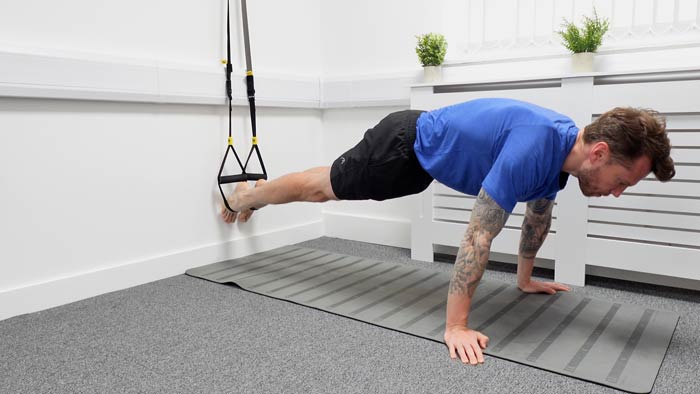
This simple exercise teaches your shoulders how to stay locked and stable under tension.
From there, you can level up to single-arm plank holds, challenging each shoulder individually.
I get it. These aren’t glamorous, social-media exercises.
But trust me, this is the difference between strong, pain-free shoulders and years of nagging discomfort.
If you want to spice things up, you can add leg movements to engage your core and increase instability, or even flow in and out of pike presses.
But honestly, that’s just getting fancy for fancy’s sake.
Stick to the basics. Plank holds are your simplest, safest and most effective route to rock-solid shoulder stability.
Bodyweight training often gets labelled the “easy” option, but the truth is it’s tougher.
It demands precise body control, sharp awareness and, most importantly, what I call “muscle-centric technique”.
More TRX Guides by Body Part
- TRX Chest Exercises
- TRX Arm Exercises
- TRX Core Exercises
- TRX Back Exercises
- TRX Leg Exercises
- TRX Shoulder Exercises
FAQ
Can you build shoulder muscle with a TRX?
Yes. Your shoulders don’t understand weight. They only recognise tension. Slow 6-second reps, a hard squeeze at the top and never hanging at the bottom keep your delts under constant tension, and that’s what builds muscle. I rebuilt my shoulders this way in my thirties after years of heavy lifting left me in pain.
What is the best TRX exercise for shoulders?
For width, the TRX Y Raise. It targets your side delt, the muscle that makes shoulders look wide. But your shoulders are three muscles, so no single exercise covers them all. Pair Y’s with T’s and face pulls for your rear delts, and the shoulder press for your fronts, and you’ve hit every head.
How do you get wider shoulders with a TRX?
Focus on your side delts with Y raises, and your rear delts with T raises. Keep your shoulders centred with a short range of motion so your upper back doesn’t take over, and progress your angle only once you can do 15 clean reps. For an extra push, superset 12 Y’s straight into 12 T’s.
Is TRX good for shoulder pain?
It can be, because the slow, controlled movements build strength without the heavy joint loading that caused my own shoulder problems. Plank holds also build the rotator cuff stability that keeps your shoulders locked in place. If you have an existing injury, though, check with a doctor or physio first, and stop anything that causes pain.
How often should you do TRX shoulder exercises?
2–3 times per week works well for most people, with a rest day in between. Your shoulders also work as secondary muscles in most chest, back and arm exercises, so they’re getting more training than you think. Focus on quality reps rather than piling on extra volume.
Can you get bigger shoulders without weights?
Absolutely. When I swapped heavy barbells for a suspension trainer, my shoulders grew faster than ever, and my shoulder pain disappeared. The key is building a strong mind-muscle connection: squeeze before you move, control every rep, and never lock out. Progress by slowing your tempo and increasing your angle.
But here’s the thing…
If you’ve got strong, wide shoulders on a body where everything else is lagging behind, you’re still going to look and feel half-built.
To get the best results, combine this shoulder training with full-body muscle building.
So check out this post next, and I’ll show you the 8 essential TRX moves everyone needs to master to build full-body muscle, strength and mobility. I’ve also put together a free 4-week workout plan built around those moves. It’s sitting inside that post, ready for you to download.
Here’s to your Fitness Freedom!
Coach Adam, aka TRX Traveller

0 Comments