

The reason you’re still stiff isn’t that you’re not stretching enough…
It’s that stretching alone was never going to fix it.
You feel it every day…
- Hips that lock up when you stand from your desk…
- Shoulders rounded forward by mid-afternoon…
- And a deep squat that’s become something you used to be able to do….

So in this post I’m going to show you five follow-along TRX mobility workouts, right here on this page, that fix exactly that.
And I’ll walk you through how to do each one.
Plus, below, there’s a free downloadable 4-week plan of these workouts in case you want to do them at your own pace…

Free Total Mobility in 4-Weeks (Suspension Trainer Plan)
Loosen tight hips, free up a stiff spine, and move like your body is 10 years younger. Just tell me where to send it…
But first, let me show you why loading your joints through their full range with a TRX restores mobility in a way stretching never can…
Why a suspension trainer is one of the best tools for mobility
A suspension trainer takes some of your bodyweight load off, so you can actively move into deeper positions than you could unsupported…
And build strength at that new range at the same time.
Range of motion you can’t control isn’t much use.
When you own a position with a bit of strength behind it, it sticks…

So instead of passively hanging out in a stretch, you’re using the TRX straps to:
- Sink into a deep squat without tipping over, and stand back up under control
- Open the chest and pull the shoulders back into the position a desk steals from you
- Move the spine through rotation and extension it rarely gets during the day
- Wake up the glutes, core and hamstrings that switch off when you sit
All of it with one tool, anywhere. No gym, no floor full of equipment.
Now you know the benefits, let’s start the workouts…
The 5 follow-along TRX mobility workouts
This is the full TRX Total Mobility series. Start with the first video, it includes a short intro on the technique before the workout.
Then work through the rest in order.
The warm-up and cool-down are below the workouts.
Workout 1 — Unlock Total Body Mobility (start here)
Your foundation session. This is where I explain the “muscle-centric” technique that makes the difference, then take you through all five key moves at a controlled tempo.
Workout 2 — Loosen Tight Hips & Spine
The hip-and-spine session. If sitting all day has locked up your hips and stiffened your lower back, this is the one you’ll feel the most.
Workout 3 — Deepen Your Mobility (Full Body)
Now we push the range a little further. Same movements, deeper positions and longer holds as your body starts to trust the new range.
Workout 4 — Open Tight Hips & Shoulders
A longer session targeting the two areas a desk-bound life punishes most: tight hips and rounded, closed-off shoulders.
Workout 5 — Build Mobility & Strength
The session that ties it together — mobility and the strength to hold it, so you’re not just bendier, you’re more capable.
6 Min Full Body Warm Up
This is a 6 minute full body warm up you can follow along to before your workouts. Stick with it consistently and you’ll quickly memorise the sequence, it’ll become second nature and you won’t need to keep the video on!
Think of this as a starting point rather than a strict routine. Make it your own. If you’ve got tight hamstrings, for example, spend a little longer on some slow, deep front lunges to open them up.
8 Min Full Body Cool Down
This is a 8 minute full body cool down you can follow along to after your workouts. Work through it consistently and you’ll quickly learn the sequence, it’ll become second nature before you know it.
We work from top to bottom, stretching out all the major muscle groups to support recovery, reduce soreness, and bring your body back to a calm, grounded state. This is your time to slow down, breathe, and set yourself up for a focused and productive rest of the day.
Think of this as a starting point, make it your own! If one side feels tighter than the other, that’s completely normal. Spend a little longer there and it will balance out over time.
The 5 moves doing the heavy lifting
Every session above is built on the same five exercises.
These are the five I come back to again and again, because between them they hit the exact spots a desk-bound life locks up:
- your rounded shoulders
- tight hips
- stiff spine
- and the weak links in your core, glutes and hamstrings.
Here’s how to perform each one well.
The theme running through all of them:
- Slow and controlled beats fast and sloppy every time.
- Aim for a 2-2-2 tempo: two seconds up, a two-second squeeze at the top, two seconds lowering, unless a move is a timed hold.
1. Face Pulls — for your rounded shoulders
The single best move for undoing a hunched, forward-shoulder posture.

- Do it: Lean back holding the handles, arms extended. Drive your hands towards your nose, rotating your knuckles up at the top, and squeeze your shoulder blades together. Keep a slight bend in the arms at the bottom.
- Common fault: Pulling with the arms and letting the shoulders shrug up. The work should come from squeezing the shoulder blades together, not from the biceps.
2. Primal Squat — for tight hips and legs
Rebuilds the deep squat most adults lose somewhere in their 30s.

- Do it: Feet just outside shoulder width, toes turned slightly out. Hold the handles, lean back for support, and sink down slowly — building depth over time — then drive back up. Let the straps take just enough weight that you can go deeper than you could on your own.
- Common fault: Rushing to the bottom and bouncing up. Control the descent; the slow lowering is where the mobility is built.
3. Climbers / Tucks / Pike — for the postural chain
The core-and-shoulder move that ties everything together.

- Do it: With feet in the straps and hands on the floor, move through your chosen variation (climbers, tucks or pike) with the abs squeezed the whole time. Pause at the top and bottom.
- Common fault: Swinging and using momentum. Stay in control the entire rep. No rushing, no swinging.
4. Single-Leg Glute Bridge — for your glutes
Switches on the glutes that go quiet from all-day sitting.

- Do it: On your back, one heel in the strap. Lift your bum an inch off the floor, then squeeze the glute to raise your hips, hold at the top, and lower slowly.
- Common fault: Pushing the hips up with the lower back instead of the glute. Feel the glute do the lifting.
5. Thoracic Extension — for your stiff spine
Restores the upper-back extension a keyboard steals all day.

- Do it: Kneel and sit back on your heels, arms overhead holding the straps in a neutral position. Gently push your chest towards the ground, keeping your chin up.
- Common fault: Cranking through the lower back. The stretch should open the upper back and chest, not compress your lumbar spine.
How to turn these into a simple 4-week routine
Follow-along sessions are great for pressing play.
But if you want mobility that lasts, you need to progress, a little more range and challenge each week.
That’s how a stretch you do once becomes movement you actually own.
Here’s the structure I use, and it’s the exact plan inside the free download below:
- Block 1 (Weeks 1–2) — Technique first. Two short sessions a week. The whole job here is nailing the movement and building the mind-muscle connection. Resist the urge to push hard — get the execution right.
- Block 2 (Weeks 3–4) — Add the challenge. Three sessions a week. Now we deepen the positions, hold longer, and pair moves back-to-back to raise the intensity.
Keep it simple:
- Leave at least one rest day between sessions
- Do it before work to loosen up for the day, or as a warm-up to your existing training
- Go by how your body feels, if you need two rest days between sessions early on, take them
How often should you do this, and who is it for?
This is built for people with low-to-average fitness who are newer to mobility work with a suspension trainer, which is most people who’ve spent a decade or two at a desk.
Two to three short sessions a week is the sweet spot: often enough to build real change, light enough to fit around a busy life.
You don’t need to be flexible to start. You don’t need a gym. You need a suspension trainer, a door or anchor point, and ten minutes.
FAQ
Is a TRX good for mobility?
Yes — arguably better than stretching for it. Because the straps unload some of your bodyweight, you can move into deeper positions safely and build strength there, so the new range actually sticks.
How often should I do TRX mobility work?
Two to three short sessions a week is ideal for most people. Even 5–10 minutes a day makes a noticeable difference within a few weeks.
Can beginners do TRX mobility workouts?
Absolutely. Start with Workout 1 above, keep the movements slow and controlled, and only add depth and intensity once the technique feels solid.
Do I need a real TRX, or will any suspension trainer work?
Any decent suspension trainer works. TRX is the best-known brand, but the technique matters far more than the badge on the straps.
Mobility or flexibility — what’s the difference?
Flexibility is how far a joint can move passively. Mobility is how well you can move and control it actively. These workouts build the second, which is the one that helps you squat, bend and move well in real life.
Take the next step: the free 4-week Total Mobility plan
The videos above will loosen you up today.
But if you want to keep the progress, moving deeper and feeling stronger week after week, grab the free plan that goes with this series.
The Total Mobility Plan lays the five moves out across a structured 4-week progression, with sets, reps, tempo and a rep tracker, plus the guided warm-up and cool-down.
It’s the difference between doing a random mobility session and actually building lasting change.
Free Total Mobility in 4-Weeks (Suspension Trainer Plan)
Loosen tight hips, free up a stiff spine, and move like your body is 10 years younger. Just tell me where to send it…
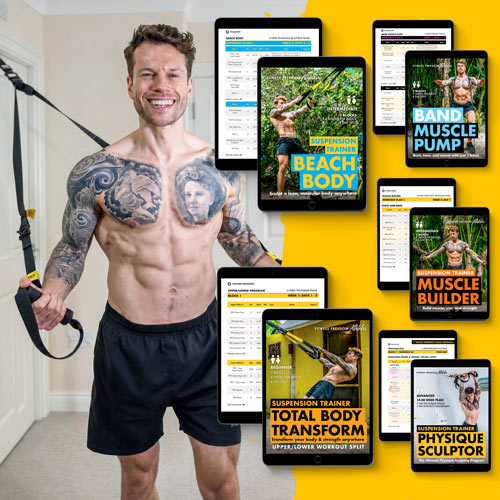
And once you’ve moved freely again, if you want to go further and start building lean muscle and strength with the same suspension trainer…
that’s exactly what my Suspension Trainer Body Transformation Programs are for.
Here’s to your Fitness Freedom
Coach Adam
Aka TRX Traveller
Founder, Fitness Freedom Athletes


0 Comments