

If you want the how and why of building lean muscle with just a suspension trainer, this guide is for you…
These 7 skills are different to anything you’ve seen before.
Most people mindlessly move with a suspension trainer. Randomly pushing, pulling and hanging, never actually changing their body.
These 7 skills change that completely…
They turn suspension training from cardio-style movement into a tool that builds real, lean muscle and reshapes your body…
Whatever your level, whatever your starting point….

So you can look and feel athletic, capable, and strong, with the energy to keep up at work and at home.
No gym memberships, no injuries, no all-or-nothing approach.
Transform your body with one tool, anywhere, for life. That’s Fitness Freedom.
Let’s start with Skill 1, because once that clicks, everything else layers on top for a greater transformation…
You can also download these 7 skills as a FREE Handbook below…
Get Your FREE Copy Of My ‘7 Skills To Build Muscle With A Suspension Trainer Handbook!’
Downloaded 70,000+ times! Just tell me where to send it:
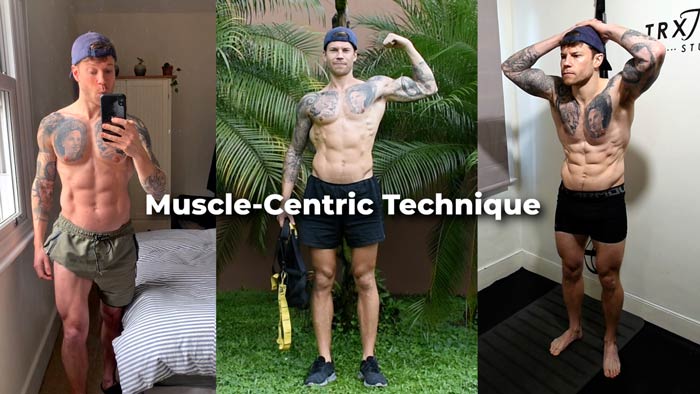
Skill 1 – The Skill of Muscle-Centric Technique
There’s a BIG difference in how people exercise to transform their bodies.
It comes down to two techniques:
- Movement-centric technique (99% of people)
- Muscle-centric technique (1% of people. This is us!)
One is far more effective for building strong, lean muscle.
That technique is called muscle-centric technique.
Don’t have time to read the post in full? Then watch the video below to learn the 7 skills to build lean muscle with a TRX suspension trainer…
The Difference
These two techniques are the difference between the person who uses a suspension trainer for months and never sees visible results.
And the person who improves their body month on month.
Let me explain why, because this will change everything…
‘Movement-Centric’ Suspension Trainer Technique
Walking, running, cycling, an aerobics class. These are all movement-centric. You don’t think about moving, you just move.
The body wants to be efficient. It wants to spread the load across as many muscles as possible because it’s easier.
Most people grab a suspension trainer and do exactly this. Jumping around, pushing, pulling, and hanging without thinking about how they’re moving. Just moving.
You see the same thing in gyms. People grunting and groaning, moving a weight that’s too heavy, sacrificing form just to get it up.
So long as they move it and look strong, they don’t care. I used to be that guy.
Here’s The Problem With That
With movement-centric technique the load is shared. Not one or two muscles take the work. Sometimes six or eight do.
Take 100% load shared across eight muscles. That’s only 12% strain for each muscle.
Fantastic teamwork by the body and mazing biomechanics of the human species. But useless for building lean muscle. Because the load on each individual muscle isn’t enough to trigger a growth stimulus.
Take the Suspension Trainer Chest Press…
Most people mindlessly press forward and back. The chest is the target but the triceps, front shoulders, back, and biceps all jump in to help,
like this…
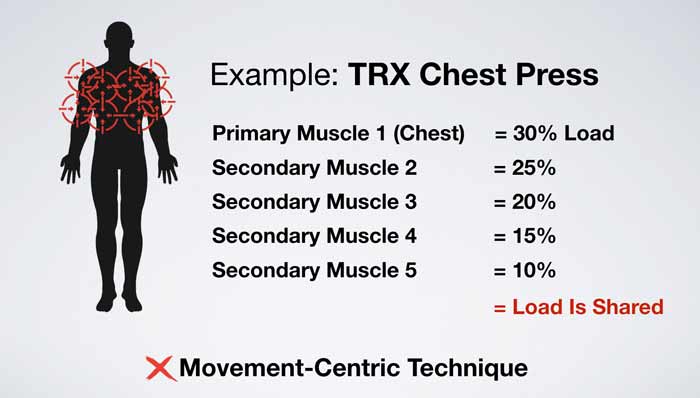
Multiple muscles sharing the load. That’s great teamwork and efficiency, but the problem is…
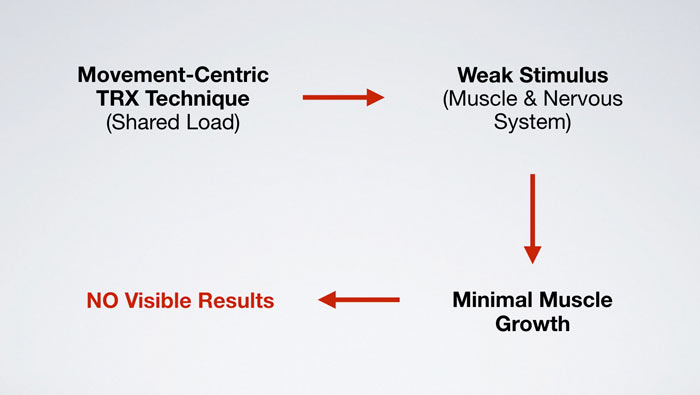
A shared load creates a very weak muscle growth stimulus on each muscle. So your body thinks:
“That’s not too hard on the chest muscle, it doesn’t need to grow stronger.”
This happens to every muscle group. So your body never changes.
This is why so many people stall. They keep changing things up out of frustration, never understanding the real reason they’re not progressing.
Instead, Do Muscle-Centric Technique
This is where you use slow, controlled movements and your powerful mind-muscle connection to isolate and target ONE muscle at a time.
Suddenly, the majority of your bodyweight goes onto that ONE target muscle:
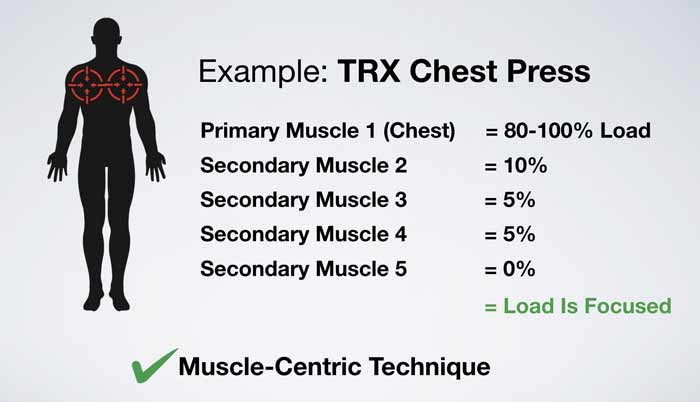
Think of it Like This…
Movement-centric is like having a whole construction crew move one heavy slab together. Easy. No single worker is really challenged.
Muscle-centric is like making one worker carry that slab alone. That worker HAS to get stronger.
That’s exactly what muscle-centric technique does to your muscles. Every single rep.
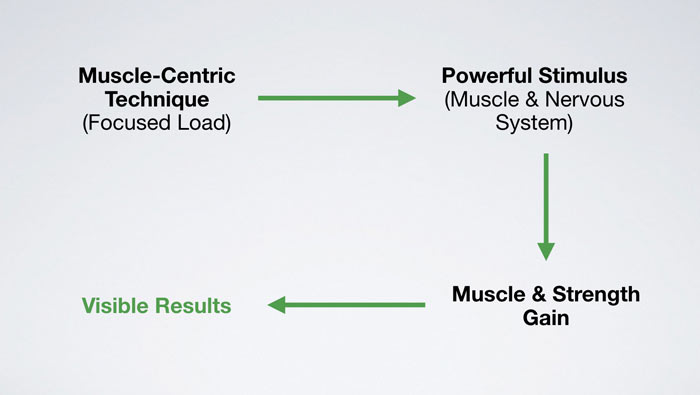
This Makes Building Muscle With a Suspension Trainer A Lot Easier
A muscle is far weaker when isolated on its own. So you can use lighter loads, like your bodyweight, to create a powerful growth stimulus.
You’ll build lean muscle faster because every workout produces a real result.
And because you’re using lighter loads with more control, you’ll build healthy balanced muscles that support your joints and improve your movement for the long term.
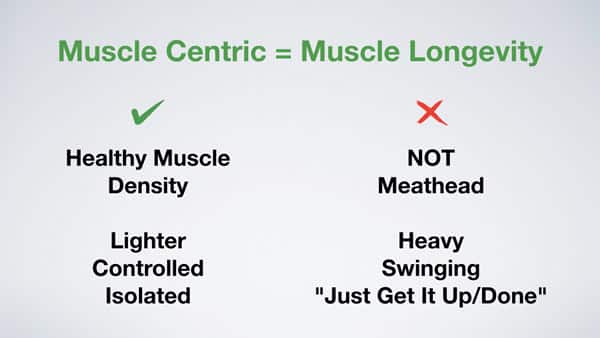
Unlike heavy weights and high impact exercise which wear joints down and lead to injury.
One tool. Any room. No gym. No weights. No excuses.
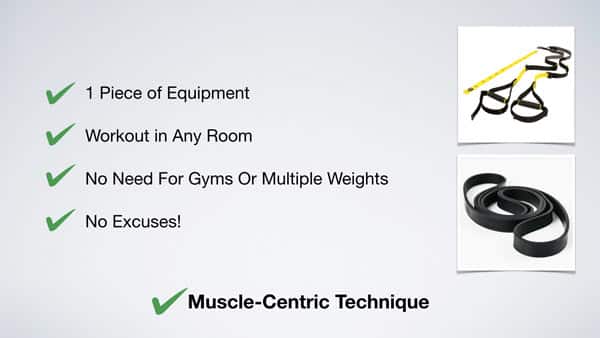
Next, I’ll show you the technique that supercharges muscle-centric training.
Master this alongside what you just learned and your workouts will transform into something you’ve never experienced before…
Skill 2 – The Skill of Mind-Muscle Connection
There’s something your mind believes that’s holding you back:
“I need a gym and weights to transform my body.”
Here’s what your muscle actually knows:
“Your muscle does NOT know where you are or what you are holding. All it knows is the tension you can place upon it through a range of motion.”
If there’s one thing you take away from this entire handbook, make it that.
What Is The Mind-Muscle Connection?
I call it the squeeze.
In the FFA community, members tease me about it. But it is very important.

The squeeze means powerfully contracting the muscle you are targeting with mindful intent throughout the entire range of motion.
Every rep. Every set.
Place your mind inside your muscle and visualise it squeezing, stretching, moving, and growing….

Focus all your attention internally on that single muscle. This internal focus is the foundation of the mind-muscle connection.
It’s mindful. And it’s the opposite of how most people train.
Most People Are Externally Focused
When people workout they think about the rep number, what exercise is next, or when it will be over.
They have life thoughts about work, money, daily conversations.
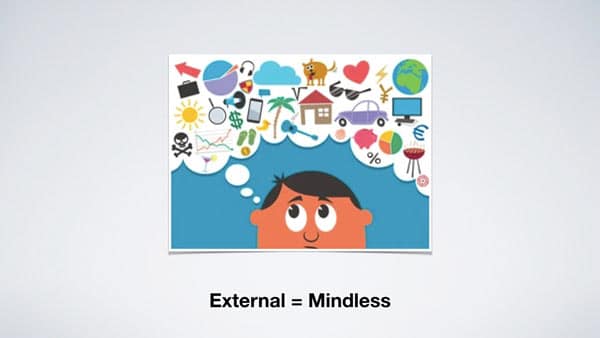
They never mindfully focus on the specific muscle they are targeting and how it actually feels.
In a gym this is almost unavoidable. The environment pulls your attention outward constantly.
But in your own space with a suspension trainer, you can close off the outside world completely. Phone out of sight. Full focus on the muscle you are training.
That’s a genuine advantage most people never use.
Workouts Become Meditation
When you internalise your focus on one specific muscle for an entire 30 to 50 minute workout, something powerful happens.
That IS meditation.
Focusing on one thing for an extended period of time.
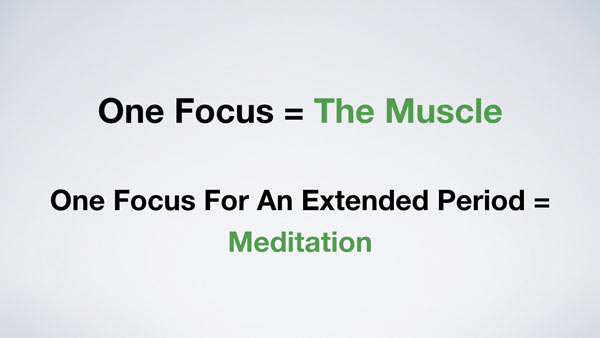
And the benefits compound. Not just physically but mentally.
Clients have reported reduced social anxiety, less procrastination, more calm and focus, better deep work, more confidence.
It’s a double whammy.
As your body improves, so does your mind. As your mind improves, so does your body. A never ending improvement circle…
This is what it means to use your body to master your mind.
Mind-Muscle Connection Is Limitless
The more you practice it, the better it gets.
Studies show that even professional bodybuilders can only contract their muscles to 50 to 60% of their full potential through mind-muscle connection.
For most of us, we’re at around 20 to 30%.
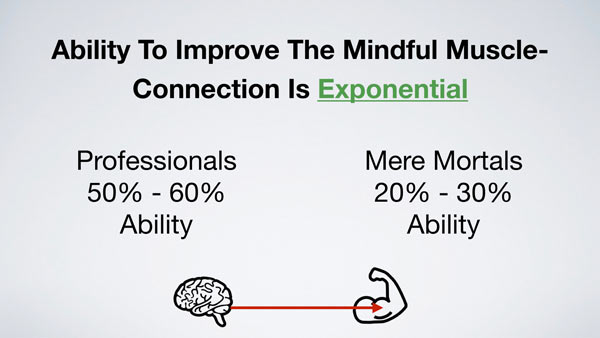
That is a huge area for improvement. And every single workout is an opportunity to close that gap.
A client once told me:
“I finally understand what a workout should be and feel like.”
That’s it exactly.
Once you feel it, it becomes addictive. You become closer to your body. You awaken pathways you never knew existed. And the results follow.
Think of it like Yoda. (Yes, I am a geek)
With just the force he’s ok. But combined with a lightsaber he’s unstoppable.
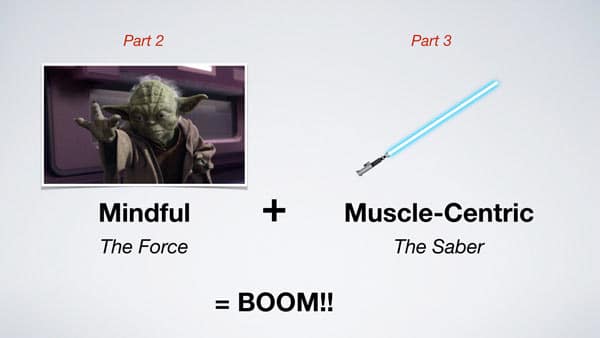
Muscle-centric technique is the lightsaber. The mind-muscle connection is the force.
Together they are incredibly powerful to transform your body.
Together, skills 1 and 2 are your foundation.
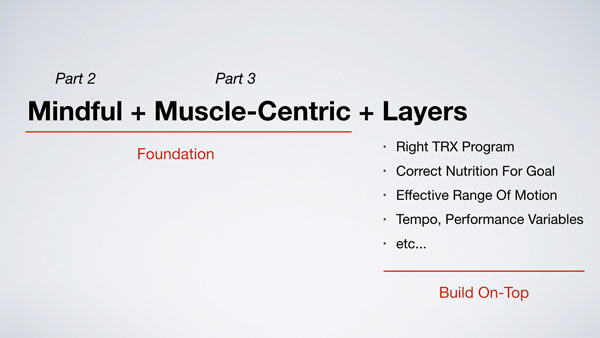
Next, I’ll show you why training harder is actually working against you, and what to focus on instead.…
By the way…
If you’re ready to put these first two skills into practice right now, then checkouy my Beginner Suspension Trainer Total Body Transformation Program is the perfect place to start.
It’s an 8 week program built entirely around muscle-centric technique.
Every workout, every exercise, every rep coached with this method from the ground up.
[Learn How To Build Lean Muscle and Transform Your Body In Just 8 Weeks Here]

Skill 3 – The Skill of NOT Working Hard
One of the biggest mistakes I see today is the idea of training HARD.
Sapping all your energy. Pushing through pain. Doing more, more, more.
Simply training hard is stupid.
And it’s often the reason joint problems and injuries occur.
It’s Not About Hard Work. It’s About Smart Work.
Think about learning to play guitar for the first time. It’s going to sound terrible.
Now imagine your coach sitting next to you screaming:
“play harder and faster!”
That doesn’t help. It makes things worse.
The same is true here. Technique mastery always comes before hard work. Always. The question you should be asking yourself in every workout is not…
“how many reps can I do?” or “how fast can I go?” or “how many exercises can I fit in?”…
It’s simply this: “How well am I performing this exercise?”
Quality Over Quantity. But Here’s The Thing…
Whilst we always want quality over quantity, you do need quantity to get to quality.
You have to put in the reps to get good enough that fewer reps deliver the same results. Practice makes perfect.
But make sure the practice is with good technique. Not doing more for the sake of doing more.
The more advanced you get with your training and mind-muscle connection, the more you’ll realise numbers become less and less relevant
They are a guide. Nothing more.
Technique and mind-muscle connection mastery always come first.
The numbers follow.
Next, I’ll show you how to develop the output and mental toughness that actually drives muscle growth.
Because knowing the right technique is one thing. Pushing into it when it gets hard is another….

Skill 4 – The Skill of Output
Knowing muscle-centric technique and having a strong mind-muscle connection means nothing if you quit too early.
That’s where output comes in.
The goal is high quality output. And that requires something most people never develop.
Relentless effort with a controlled mind.
Your Mind Will Quit Before Your Muscle Does
As you start to fatigue, your brain and nervous system send signals to stop.
But here’s the truth. You are still able to continue.
If your muscle could speak at that moment it would say:
“Why are we stopping? I’ve got another 3 quality reps in me at least!”
Think of it like a fuel warning light coming on in your car. It’s a warning but you’ve still got 50 miles to go.
When your mind tells you to stop during a set, that’s just the warning light.
You have more in the tank…
Get Comfortable Being Uncomfortable
Discomfort during a workout is not a sign to stop. It’s a sign you’re doing it right.
Feeling the burn is not a sign to stop either. It’s a signal to explore. To push further into the sensation and see what’s really there.
That gap between where your mind gives up and where your muscle actually fails is where the real growth happens.
Own that gap. That’s where bodies change.
Output Is A Skill You Build
Like every skill in this handbook, your output capacity improves with practice.
The more you train with focus and intention, the better you become at pushing into discomfort whilst maintaining perfect technique.
Not thrashing. Not grinding.
Controlled, deliberate, relentless effort on the target muscle.
Focus. Discipline. Relentless quality output.
Next, I’ll show you something most people completely overlook. It’s not an exercise or a technique.
But fixing it will immediately improve every single workout you do….

Skill 5 – The Skill of Mobility
Most people think mobility is about being tight.
Stretch more, they say. Do yoga. Foam roll.
But a lack of mobility is not just tightness. It’s a sign of weakness.
And stretching alone will not fix it.
The Real Cause of Poor Mobility
A lack of mobility is normally a lack of muscular balance.
Think about it. Muscles work in pairs.
When one shortens and contracts, the opposing muscle must lengthen.
These are called antagonistic muscle pairings. Opposing forces constantly working against each other.
When one side of that pairing is significantly stronger than the other, imbalances develop. Movement becomes restricted. Pain and tightness follow.
This is almost always caused by poor form and technique when exercising.
Not a lack of stretching….
The Fix Is Simpler Than You Think
This brings us back to Skills 1 and 2.
When you use muscle-centric technique with a strong mind-muscle connection, you fully lengthen the muscle at one end of the movement and fully contract it at the other.
That full range of motion, done consistently and correctly, is what restores muscular balance over time.
Not mindless stretching. Not foam rolling.
Building healthy, strong, balanced muscle the right way.
Clients who commit to this regularly find that imbalances which have caused them problems for years begin to quietly disappear.
Better movement. Less pain. More freedom.
Next, I’ll show you the single biggest opportunity you have to challenge and grow your muscles in every workout.
Most people completely waste it without even knowing.

Skill 6 – The Skill of Time
What if I told you the number of reps you
do is almost irrelevant?
Most people obsess over hitting a rep target.
10 reps. 12 reps. 16 reps. But reps are not
what builds muscle.
Time is.
More specifically, the amount of time your muscle
spends under continuous tension during those reps.
Time Under Tension Is Everything
It’s not how many reps you do. It’s how long your muscle was placed under constant tension within those reps.
Maintain continuous tension on the target muscle throughout the entire exercise. Including at the very bottom and very top of every rep. Never let it off the hook.
Tension is lost the moment you stop continuous movement or allow other muscles to take over.
The second you shift, swing, or adjust during a rep, the working muscle gets a break it doesn’t need.
Remember. Your body loves to make things easier. It will look for any opportunity to share the load.
Lock your body in stone and don’t give it that opportunity….
Let’s Look At The Maths
Here are two ways to perform a TRX Chest Press:
Option 1. 16 reps with each rep taking 2 seconds = 32 seconds under tension.
Option 2. 8 reps with each rep taking 6 seconds = 48 seconds under tension.
Which builds more lean muscle? If you’re still thinking like the 99%, you said Option 1.
But we’re the 1%. And the answer is Option 2.
48 seconds of continuous tension on the target muscle versus 32. The muscle has 50% more time to be challenged, stimulated, and forced to grow. Fewer reps. Slower tempo. More results.
This Changed Everything For Me
My body dramatically changed when I truly understood and applied this.
Not from doing more. From doing less, slower, with complete focus on keeping the target muscle under tension for as long as possible.
Once you master this it makes the possibilities of suspension trainer training endless.
The ways you can intensify an exercise without adding a single kilo of weight are remarkable.
It’s a wonderful thing to master.
Next, I’ll show you how to develop the muscular endurance to actually maintain that tension for longer.
Because knowing this and being able to do it are two very different things.

Skill 7 – The Skill of Muscular Endurance
Be honest with me.
Have you ever paused at the top of a TRX Squat or a Bicep Curl for a second or two to rest?
I have. And I still do sometimes.
It’s natural. But it’s also your body taking the easy way out.
Your Body Was Designed To Be Lazy
We know the body is built for efficiency. It wants to conserve stored energy.
From an evolutionary standpoint that makes perfect sense. You might need to run from a tiger.
Exercise is no different.
As you start to fatigue, your brain and nervous system send signals to stop what you are doing.
But here’s what most people don’t realise…
Those signals are not the truth.
They are a safety mechanism. And you are still absolutely able to continue.
This Is Where Muscular Endurance Comes In
Muscular endurance is your ability to keep the target muscle under tension for longer before it actually fails.
Not where your mind says stop. Where the muscle genuinely cannot continue.
That gap between the two is enormous for most people. And closing it is where the real transformation happens.
This skill grows directly out of Skill 6…
The more you practice time under tension, the more you challenge your muscular endurance. The more you challenge your muscular endurance, the longer you can sustain tension. The longer you sustain tension, the more your muscles grow.
They feed each other.
What Improving Muscular Endurance Actually Does
As your muscular endurance improves, your muscles become better at producing energy and clearing waste products during exercise.
This increases your work capacity, muscular stability, and strength over time.
In simple terms. You can push harder and go further than you ever could before.
And here’s a bonus most people don’t expect…
Improved muscular endurance makes fat loss significantly easier…
As your muscles become more efficient they get better at using fat as their primary fuel source.
More muscle. Less fat. More endurance.
All from learning to ignore a warning signal and keep going.
Make It Your Goal
Every workout, make it your intention to push past that first signal to stop.
Not recklessly. Not with broken technique. With controlled, focused effort on the target muscle.
Own that extra rep. Own that extra second of tension.
That is the rep that changes your body.
That’s the 7 Skills.
But before I show you how to put them all into practice, there’s one bonus skill I want to share with you.
It costs nothing, requires no equipment, and most people are doing it completely wrong every single day…
Bonus Skill 8 – The Skill of Breathing
Most people never think about how they breathe during a workout.
They should.
Because how you breathe directly affects how well you perform, how much fat you burn, and how quickly you recover.
And the good news is it costs nothing to fix.
Why Nasal Breathing Changes Everything
Practicing nasal breathing during your suspension trainer workouts improves circulation, increases oxygen availability, and raises your body’s maximum ability to produce energy in the presence of oxygen.
What scientists call VO2 Max.
In simple terms…
Your body becomes better at performing high amounts of work whilst burning fat as the primary fuel source.
That is a significant win for almost no extra effort.
Here is why it works.
The body is more efficient at oxygen and carbon dioxide exchange through nasal breathing because it utilises more lobes of the lungs.
More lung capacity means more oxygen in the cardiovascular system. More oxygen means more fat oxidised for energy and more CO2 expelled as waste.
Mouth breathing bypasses all of this. It’s less efficient, less controlled, and over time becomes a habit that limits your performance both in and out of the gym.
Think of Breathing Like Gears
Gear 1. Nasal only.
This is your default. Day to day living, sleep, and most suspension trainer workouts.
Mouth closed. Tongue to the roof of your mouth for jaw alignment. Slow controlled breaths in and out through the nose only.
It will feel challenging at first. Stick with it. You will be surprised how quickly it becomes natural. And the knock on benefits across every area of your life are significant.
Gear 2. Nose in, mouth out.
There will be moments in your workout when nasal only isn’t possible. High demand leg exercises like TRX Pistol Squats for example.
In these moments breathe in through your nose and out through your mouth.
You can move more air, supply oxygen faster, and maintain performance without fully abandoning the benefits of nasal breathing.
Gear 3. Full mouth breathing.
Reserved for maximum intensity only. A full HIIT session or sprinting up a hill.
When the session or set is over, work back down through the gears as quickly as possible until you return to nasal only.
The goal is to spend as much of your life as possible in Gear 1. Check in with yourself throughout the day. Most people are mouth breathing without even realising it.
Sleep, daily living, and suspension trainer workouts except the most demanding leg exercises.
Mouth closed. Tongue to the roof of the mouth. Breathing only through the nose.
Start small. Pick one workout this week and commit to nasal breathing throughout. Notice how it feels. Notice the difference in your focus and control.
Then make it a habit.
.
You now have all 8 skills. The question is what do you do with them?
Take my Body Transformation Quiz here, and I’ll show you exactly how to put everything you’ve learned into a complete structured program…
So you can start building lean muscle and transforming your body straight away….
Your TRX Muscle Building Guide,
Coach Adam
aka TRX Traveller

0 Comments