
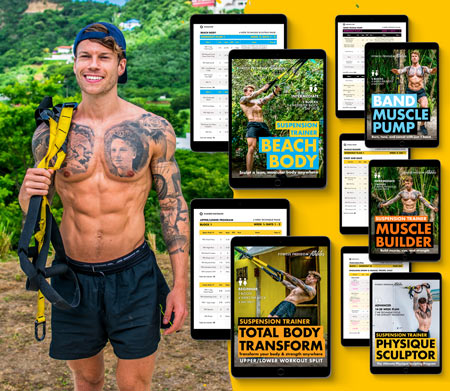
 I hope you enjoy this post. If you want my help to build lean muscle & transform your body using a TRX suspension trainer anywhere –
 I spent 5 years training the wrong way.
2008-2013.
Personal trainer in London. Working in gyms daily. Training myself 6 days a week.
And making tiny progress.
My physique?
Pretty much the same year after year.
Sure, I was in decent shape. Better than most people.
But for someone dedicating 90 minutes a day, 6 days a week to training?
I should’ve looked ALOT better.
Instead, I looked… average fit.
I was spinning my wheels.
Doing the same things over and over.
Getting minimal results.
Making three massive mistakes that were completely sabotaging my progress…
Mistake #1: I believed “heavy weight = muscle growth”
This was gospel in gym culture.
Everyone was obsessed with their numbers.
“How much do you bench?”
“What’s your max squat?”
So I chased heavy weights too.
Every session, I’d try to lift more.
Add another plate, another plate.
My ego was completely wrapped up in the numbers.
Using my chest, shoulders, triceps, back, legs, core literally my entire body to move the heavy weight.
And I’d feel accomplished when I hit a new max.
But here’s what I didn’t realise:
When you lift heavy, your body recruits as many muscles as possible.
Because it’s trying to move the load efficiently and safely.
It’s smart.
It knows engaging more muscles makes the task easier.
So heavy bench press?
My chest was only doing maybe 30-40% of the work.
Heavy squat?
My quads, hamstrings, glutes, back, core all sharing the load.
Now don’t get me wrong. You can and will build muscle this way.
But it’s not the most effective and easiest way to build lean muscle safely…
A shared load means no single muscle was getting a strong muscle growth signal.
I was getting stronger at the MOVEMENT (coordinating multiple muscles), for sure.
But not significantly bigger in any specific muscle area.
Plus, lifting heavy meant:
- Constant joint pain (knees, shoulders, lower back)
- Higher injury risk (tweaked muscles regularly)
- Longer recovery needed (systemically fatiguing)
- Plateaus (couldn’t keep adding weight forever)
- Big time sacrifice
Looking back, it’s so obvious.
But at the time, I was convinced heavy lifting was the only path to muscle growth.
Instead, if you isolate a muscle, it is much weaker on it’s own.
So you cna use lighter loads, like your bodyweight with a suspension trainer, to create a lean msucle growth stimulus.
Mistake #2: I believed “more reps = more muscle”
When heavy lifting didn’t work, I tried the opposite.
“Maybe I need more volume. More reps. More sets. More exercises.”
So I’d do workouts like:
Chest day:
- Flat bench press: 5 sets x 15 reps
- Incline bench: 5 sets x 15 reps
- Decline bench: 4 sets x 12 reps
- Dumbbell flyes: 4 sets x 15 reps
- Cable crossovers: 3 sets x 20 reps
That’s 21 sets. Probably 200+ reps total for chest alone.
Sessions lasting 90 minutes.
I’d leave the gym absolutely destroyed. Could barely lift my arms.
Surely THIS would build muscle, right?
It did, but was it sustainable (I mean just look at that list?)
Was it the most effective way?
Nope.
Instead of focusing on exercises and rep numbers, I should have focused on time under tension.
I was only focused on moving weight around quickly.
Bouncing. Using momentum.
Not actual focused tension on the target muscle.
I was confusing “exhaustion” with “effective training.”
Yes, I was tired after those workouts.
But tired from systemically fatiguing my entire body.
Not from creating sufficient mechanical tension on target muscles.
The research is clear:
Muscle grows from time under tension, not rep count.
8 reps at 6 seconds per rep = 48 seconds of tension.
15 reps at 2 seconds per rep = 30 seconds of tension.
The 8 reps create MORE growth stimulus despite being fewer reps.
But I didn’t know this.
So I chased high rep counts, burned myself out, and questioned how I could maintain it.
Now approaching 40 running a business with two kids, I can’t afford burn out.
Now I focus on quality of movement rather than quantity, with one or two exercises per target muscle, and my results have never been better.
Mistake #3: I believed “eat more = build muscle” (bulking)
This one did the most damage.
I’d read all the bodybuilding advice: “You need a calorie surplus to build muscle. Eat big to get big.”
So I did.
I’d “bulk” for 3-4 months. Eating everything. Aiming for 4,000+ calories per day.
Tons of carbs. Every meal. Snacks between meals.
The goal: “Feed the muscles.”
I did build muscle during those bulks.
But I also built significant fat.
My face would get puffy.
My waist would expand.
My abs would disappear.
I’d tell myself it was necessary. “Bulking phase. Need the calories for growth.”
Then I’d “cut” for 2-3 months to lose the fat.
Drastically reduce calories. Add more cardio. Try to preserve muscle while losing fat.
And inevitably, I’d lose some of the muscle I’d built during the bulk.
So the net result after a 6-month bulk/cut cycle?
Maybe 2-3 pounds of actual muscle gain.
While my body went through:
- Insulin resistance (from constant carb loading)
- Hormone disruption (from extreme bulking and cutting)
- Joint stress (from carrying extra weight)
- Mental stress (from restrictive cutting)
The problem was my insulin sensitivity.
When you constantly eat carbs to bulk, you’re constantly spiking insulin.
Eventually, your cells become resistant to insulin.
Which means they can’t absorb nutrients effectively.
So the food you eat doesn’t go to muscle cells for growth.
It goes to fat cells for storage (they don’t have insulin resistance).
I was eating MORE but building LESS muscle because my metabolism was broken.
Plus, all that extra weight put stress on my joints and made training uncomfortable.
So by 2013, after 5 years of this approach:
I was:
- Lifting heavy (joint pain, minimal muscle growth)
- Doing high reps (exhausted but not growing)
- Bulking and cutting (spinning my wheels, insulin resistant)
And I looked pretty much the same.
Maybe 10 pounds heavier. But not dramatically more muscular.
Five years of dedicated training. Minimal results.
Something had to change.
That’s when I left London and the gym world and everything shifted.
Traveling with just a TRX suspension trainer forced me to abandon those three mistakes.
I couldn’t lift heavy (no heavy weights available).
So I learned to isolate muscles and create tension with bodyweight.
I couldn’t do endless volume (limited time, limited access).
So I learned to make each rep count with slow, controlled tempo.
I couldn’t bulk (limited budget, couldn’t afford to eat constantly).
So I learned to optimise insulin sensitivity and build muscle while staying lean.
And for the first time in 5 years, I made REAL progress.
Visible muscle growth.
Better definition.
Improved strength.
Without heavy weights. Without high volume. Without bulking.
These are the three lessons I teach in all my Programs:
Lesson #1: Isolation over heavy weight
Focus on isolating target muscles.
Use lighter loads (even bodyweight) with perfect technique.
Create focused tension on ONE muscle at a time.
This creates bigger growth stimulus than heavy weights shared across multiple muscles.
Lesson #2: Time under tension over rep count
Slow down your reps (6 seconds per rep).
Maintain constant tension on the muscle.
Fewer reps with longer tension = more growth.
Quality over quantity.
Lesson #3: Insulin sensitivity over calories
Time your carbs strategically (around workouts).
Keep one meal carb-free (usually dinner).
Build muscle while staying lean (body recomposition).
No more bulking and cutting cycles.
Learn from my mistakes and do it right from day one.
Here’s to your Fitness Freedom!
Coach Adam
Founder, Fitness Freedom Athletes




0 Comments