
Bit of a personal one today,
but it taught me something important about fitness that nobody talks about.
About a year ago, my better-half mentioned her hair was falling out.
Not just a few strands.
Noticeable amounts.
Enough that we were finding clumps all over the house.
We both have a passion for health and fitness, so I didn’t think it was related to nutrition or lack of exercise.
We thought maybe she should try a supplement.
Or a special shampoo.
Standard stuff.
But it kept getting worse.
One evening, she was really upset about it.
Then a little bell went off in my head.
I asked her to log her food in MyFitnessPal for a few days. Every little detail.
She did.
I dove into her nutritional profile for each day..
And there it was.
Her vitamin A intake was over 400% of the recommended daily amount…
From “healthy” foods:
- Lots of leafy greens (huge salads), carrots, sweet potato.
- Plus a multivitamin that had A LOT of vitamin A in it.
All good stuff on its own.
But when you add it all up, it was way too much.
Becuase excess vitamin A can cause hair loss.
We made a simple adjustment.
She stopped the multivitamin (didn’t need it anyway)…
Cut back on the vitamin A-rich leafy greens a bit…
And tracked her intake for a few weeks to make sure it stayed in the normal range.
Within a month, her hair stopped falling out.
Within four months, it was back to its normal thickness.
Problem solved.
Here’s why I’m telling you this:
Most people think tracking food is just for weight loss.
Counting calories to get lean or whatever.
And yeah, it can be used that way.
But the real power of tracking is understanding what’s happening INSIDE your body.
Not just “am I eating too much?”
But
“am I getting enough potassium?
Too much fiber?
The right balance of fats to support hormone production?”
This stuff matters way more than most people realise.
Let me give you another example from my own experience.
Few years back, I was constantly bloated.
Very gassy (sorry, but it’s relevant).
I was eating super healthy.
Tons of vegetables. Lots of fiber. “Clean” foods.
Couldn’t figure out what was wrong.
Finally decided to actually track my nutrition properly for a week.
Not just calories, but the full nutrient breakdown.
Turns out I was getting 110 grams of fiber per day.
Recommended amount is about 50 grams.
My beloved oats for breakfast were loading me up with fiber.
Combined with all the vegetables, I was more than doubling what my gut could handle.
I swapped the oats for rice flour and cut back on the super high-fiber vegetables.
Within three days, all the bloating and discomfort disappeared.
Never came back.
This is what I mean by tracking as data, not vanity.
Most people avoid tracking because they think it’s about restriction.
Obsessing over calories. Feeling guilty about food.
But when you track properly, you’re gathering information about how YOUR specific body works.
For example:
Energy levels: If your potassium intake is lower than your sodium, you’ll struggle with low energy. No amount of coffee fixes that.
You need about 3,500mg of potassium daily from leafy greens and vegetables.
Most people get maybe 1,500mg while getting 3,000mg+ of sodium.
That imbalance tanks your energy. But you’d never know without tracking.
Hormone health: If your fat intake is too low, your body can’t produce hormones properly.
For men, that means low testosterone. Man boobs. Low sex drive.
For women, that means irregular cycles, mood swings, water retention.
But people follow “low fat” diets thinking it’s healthy.
Track your fats for a week.
See if you’re actually getting enough. You might be surprised.
Muscle building: If you’re not hitting around 1.6-2.2g of protein per kg of bodyweight, you’re making muscle growth way harder than it needs to be.
But most people just guess at their protein intake:
“Yeah, I had chicken at lunch, probably got enough.”
Track it for a week. You probably didn’t.
The point isn’t to track forever.
It’s to track for 2-4 weeks to LEARN about your body.
What does 30 grams of protein actually look like on your plate?
How many vegetables do you need to hit your potassium target?
Are you actually getting enough healthy fats?
Once you learn these patterns, you can eat intuitively and know you’re getting what you need.
I teach this in my Lean Lifestyle Nutrition Blueprint for FFA members.
It’s not about giving you a meal plan to follow blindly.
It’s about teaching you how to understand your body’s needs.
How to track strategically (not obsessively).
How to optimise your nutrition based on actual data, not guesswork.
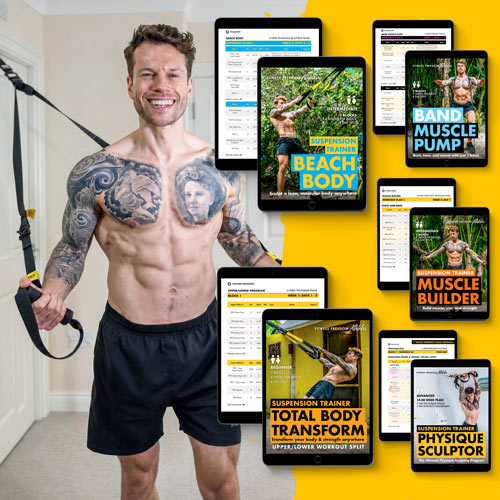
It comes free with all my Suspension Trainer Body Transfoirmation Programs
Because here’s the thing:
You can do perfect muscle-centric technique.
You can nail your workouts.
You can be super consistent.
But if your nutrition is off…
If you’re not getting the nutrients your body needs to build muscle, produce hormones, and maintain energy…
You’ll struggle.
My wife’s hair loss was a nutrition issue, not a medical issue.
My bloating was a nutrition issue.
Your afternoon energy crashes?
Probably a nutrition issue (potassium/sodium balance).
Your struggle to build muscle despite training hard?
Might be a nutrition issue (not enough protein, or poor insulin sensitivity preventing nutrient absorption).
Track for 2-4 weeks. See what the data tells you.
You don’t need to buy anything from me to do this.
Download MyFitnessPal for free. Log everything you eat for two weeks. Look at the full nutrient breakdown, not just calories.
See what surprises you.
Then make adjustments based on what you learn.
See what your body’s trying to tell you.
Here’s to your Fitness Freedom!
Coach Adam
Founder, Fitness Freedom Athletes
P.S.
The potassium/sodium thing – game changer for energy. Most people are walking around exhausted not because they need more coffee, but because they need more leafy greens.


0 Comments