

What if just 5 TRX exercises could eliminate knee pain and dramatically transform your leg strength?
Most adults are quad-dominant, with weak hamstrings that can’t keep up…
Creating a dangerous muscular imbalance.

But after coaching 8000+ busy adults with suspension training…
I’m going to show you the roadmap to rebalance and rebuild your leg muscles using 5 TRX exercises…

So you can:
- Heal knee pain
- Improve leg endurance
- Develop complete leg strength for sports, stairs, and busy adult life.
But first, you need to understand why your knees hurt and why squats aren’t the problem…
Once your knees feel stronger, you can progress with my 15 most effective TRX leg exercises.
Don’t have time to read the post in full? Then watch the video below to learn the 5 TRX exercises that will CHANGE your legs forever…
Why Your Knees Hurt (And Why Squats Aren’t the Problem)
For years, even as a personal trainer, I battled constant knee pain.
Every squat… pain. Walking downstairs… pain. Picking something up off the floor… you guessed it, pain.
I tried everything: physio, expert advice, avoiding exercises. Nothing worked. Even when I ditched the gym and switched to a suspension trainer, the pain stayed.
Because I was making the same mistake most people make: I was loading my joints instead of my muscles.
Most people think a squat is just moving up and down….

That’s movement-centric technique, and it puts the majority of the load on your knee joint, not your muscles.
What changed everything for me was applying muscle-centric technique.
Before you squat, decide which muscle you want to target:
- The back of your legs (hamstrings and glutes): use wide squats, like Exercise 3 below.
- The front of your legs (quads): use narrow squats, like Exercise 5 below.
Each approach uses a different technique to put the load onto the muscle and take it away from the joint.
When you focus on targeting the muscle instead of just doing the movement…
You build strong leg muscles that support your knees, instead of wearing your joints out.
I went from dreading every squat to actually enjoying leg workouts.
By the way, in the video below, I show you these squat techniques in full:
A quick safety note: if you have a diagnosed knee injury or sharp pain, check with your doctor or physio before starting. Stay in a range that feels comfortable, and stop anything that makes the pain worse.
Now, let me show you how to unlock your mind-muscle connection and dynamic leg flexibility…
Exercise 1 – Dynamic Flexibility
Most people’s legs are like two elastic bands.
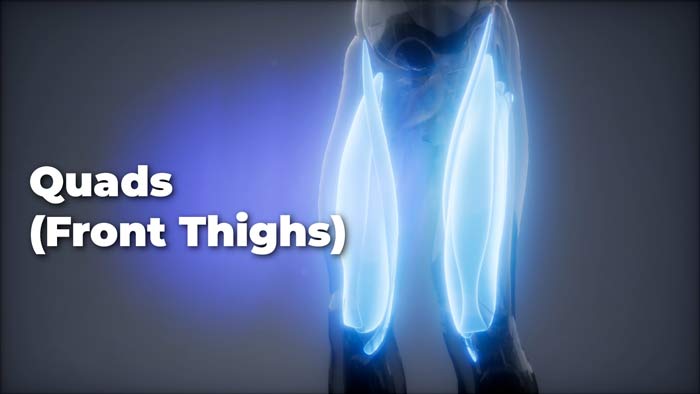
One side is thick, strong, and flexible: your quads (front thighs)….
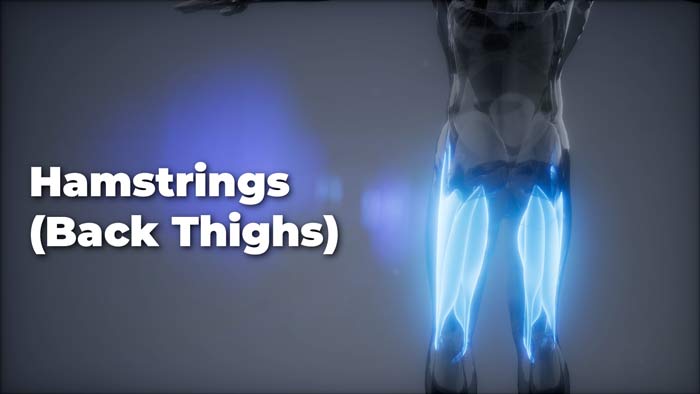
The other side is thin, brittle, and ready to snap: your hamstrings (back of legs)…
And that’s the problem:
If your hamstrings are too stiff to effectively move through a full range…
And you can’t even feel them contract…
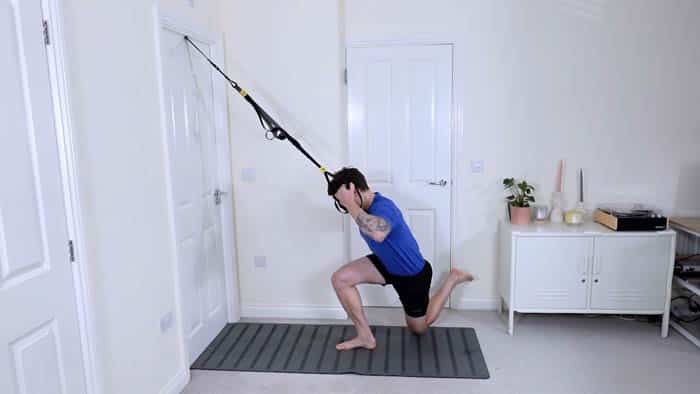
You can’t train them properly…
Plus, this hamstring stiffness locks up your hips and limits your mobility
You don’t want to be that guy who can’t bend over to tie their shoes without pain at 50
So this first step is about building dynamic flexibility and your mind-muscle connection in one go.
Let me show you in this video at 03:28…
- Start standing upright with a shoulder-width stance and feet straight
- Then create a slight angle by leaning back into the straps
- Slowly hinge at your hips over 2 seconds, pushing them back while keeping your legs slightly bent.
- Lower until you feel a deep hamstring stretch and pause for 2 seconds – This recruits muscle fibers that most exercises ignore
- Drive your hips forward in a slow thrusting movement by squeezing your hamstrings really hard
- Then hold that squeeze at the top for 2 seconds
Visualise your hamstring muscles contracting powerfully
This internal connection ensures the hamstrings are fully engaged.
Over time this improves their muscle activation for all exercises, leading to better growth.
I’m going to cover sets and reps for each exercise at the end.
Next, let’s strengthen the smallest leg muscle that will cripple your entire mobility if it’s weak.

Free ‘Bulletproof Legs in 4 Weeks (Suspension Trainer Plan)’
Build strong, athletic legs at home with nothing but two straps. No gym. No weights….
Exercise 2 – Calf Flexibility & Strength
Most people overlook calves because they’re small and out of sight.
But your calves are like shock absorbers on a car.
When they’re tight and weak, every step sends impact straight through your ankles, knees, and up into your lower back.
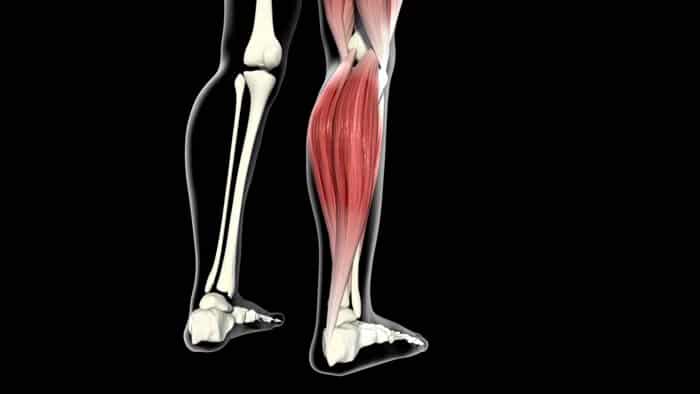
Without flexible, strong calves, you lose ankle mobility, which limits your squat depth
And increases your risk of plantar fasciitis and Achilles injuries.
Small muscles but a big impact
So how do you strengthen and improve their flexibility in one exercise?
Let me show you…
- Grab a step, thick book, or use the stairs
- Stand on the edge with the balls of your feet, starting on one leg
- Slowly lower your heel toward the ground over 2 seconds until you feel a deep calf stretch
- Then hold for 2 seconds. This stretch improves ankle mobility and prevents stiffness that leads to injuries
- Push through the balls of your feet to raise your heels as high as possible over 2 seconds
Hold that peak contraction at the top for another 2 seconds to maximise muscle activation
Using the straps as support throughout.
Next, let’s unlock your hip mobility so you can squat deep without knee pain.
Exercise 3 – Enhanced Hip Mobility
Sitting all day locks your hip muscles in a shortened position,
Like springs that have been compressed for hours and lost their ability to spring up.
When you try to squat, these tight muscles can’t lengthen properly.

So your body compensates by leaning forward and rounding your back, which shifts all the stress onto your knees and lower back.
That’s why squatting feels uncomfortable
So let me show you how to fix those hip muscles to squat pain free…
- Stand with your feet wider than shoulder-width apart, toes pointed slightly outward
- Create a slight angle by leaning back into the straps
- Before you descend, squeeze your hamstrings and glutes to activate them
- Then slowly lower into a deep squat
- Imagine you’re crushing a stability ball between your heels and bum
- At the bottom, pause for a second with your knees outward and hips back to feel a deep stretch through your hips
- Then drive through your heels and squeeze your hamstrings to rise back up over 2 seconds
At the top, don’t lock out, otherwise it transfers the tension to your quad muscles
Keep a slight bend in your knees and squeeze your hamstrings again for another 2 seconds
Now, let’s build your hamstring strength to rebalance your legs and eliminate the quad dominance.
Exercise 4 – Hamstring Strength
Think of your quads and hamstrings like a tug-of-war between 10 sumo wrestlers and 10 grannies.
The sumo wrestlers, your quads, are pulling with massive force.
The grannies, your hamstrings, are getting dragged across the line, unable to hold their ground.
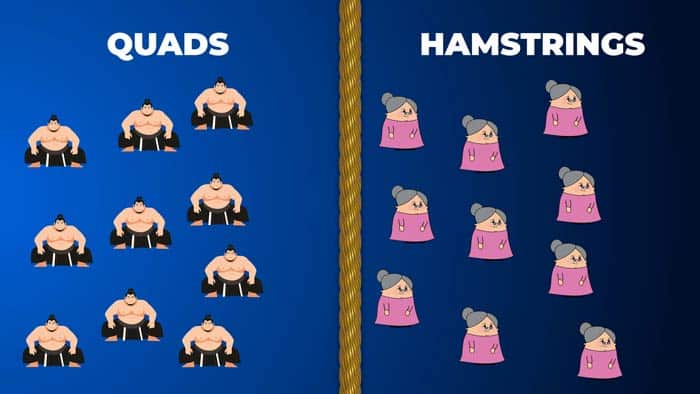
This one-sided battle creates ongoing muscle imbalances that contribute to long-term aches from your glutes…
Right up into your neck area.
That’s why you get pain from basic daily routines or after mild physical exertion.
But how do you strengthen those weak hamstrings to balance the fight?
Let me show you….
- Lie on your back with both feet in the straps, heels down
- Then lift your hips into a strong horizontal position by squeezing your glutes
- Slowly bend your knees to pull your heels toward your glutes over 2 seconds, squeezing your hamstrings hard
- Then pause at the top for another 2 seconds with an extra hard squeeze
- Slowly extend your legs back out over 2 seconds, but stop just before your legs straighten
Don’t fully straighten them and rest, or you’ll lose tension on the hamstring muscle.
Remember, maintaining tension is the number one muscle and strength-building stimulus.
Next, let’s strengthen the one muscle in your thighs that keeps you balanced under stress
Free ‘Bulletproof Legs in 4 Weeks (Suspension Trainer Plan)’
Build strong, athletic legs at home with nothing but two straps. No gym. No weights….
Exercise 5 – Athletic Performance Muscle
Most people ignore this muscle, but it’s like the co-pilot in a plane.
Your main quads are flying the plane…
But without your vastus lateralis, the outer quad muscle stabilising every movement…
You’re wobbling through turbulence with no control.
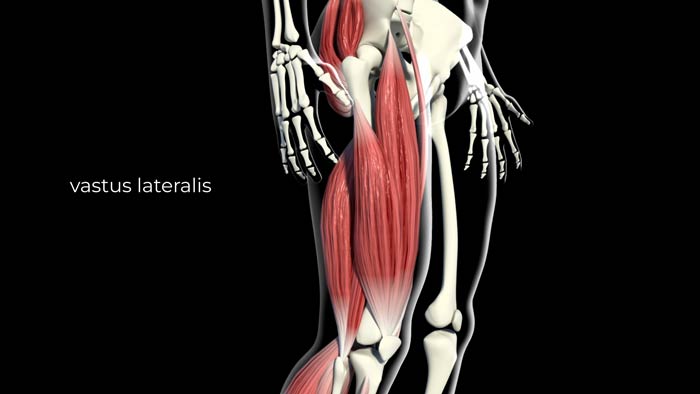
It’s the stabiliser muscle that powers explosive movements and keeps you balanced under stress.
Like when sprinting after your kids, changing direction quickly, or climbing stairs fast without fatigue.
But how do you strengthen this neglected stabilising muscle?
Let me show you…
- Stand with feet close together, pointing straight ahead.
- Before you move, push your feet outwards against the floor and squeeze your quads hard.
- Slowly squat down over 2 seconds, continuing to press outwards…
- This is crucial as it shifts tension onto your outer quads.
- Pause briefly at the bottom, keeping that outward pressure strong.
- Drive back up over 2 seconds, still pressing outwards,
- Then give an extra hard squeeze at the top for 2 seconds.
These narrow squats also reduce stress on your knee joints, helping you build leg strength safely.
Next let’s look at how many reps and sets to do for each exercise so you can build complete leg strength and mobility effectively:
Your TRX Workout for Bad Knees
Here’s how to put all 5 exercises together. Do this workout 2–3 times a week, with a rest day in between.
Move 1 – Dynamic Flexibility
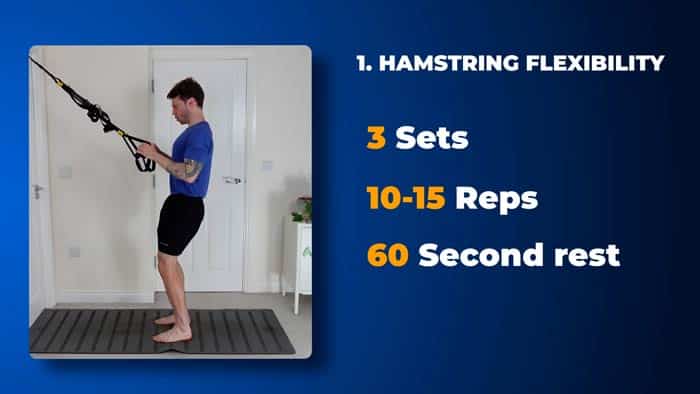
First to wake up your hamstrings’ flexibility & mind-muscle activation, do TRX Leg Extensions (TRX Deadlifts)
Go for 3 sets of 10 – 15 reps with a 60 second rest between each set
Move 2 – Calve Flexibility & Strength

Then to increase your calf flexibility and strength, do TRX calve raises.
Go for 2 sets per leg of 15 – 20 reps with a 30 seconds rest. Do one leg at a time.
Move 3 – Enhanced Hip Mobility

Then to enhance your hip mobility so you can squat deep, do TRX Wide squats.
Go for 3 sets of 10 – 15 reps with a 60 second rest between each set
Move 4 – Hamstring Strength

Then to build raw hamstring strength to balance out the quad dominance, do TRX Hamstring curls.
Go for 3 sets of 4 – 6 reps with a 60 second rest between each set
Move 5 – Athletic Performance Muscle
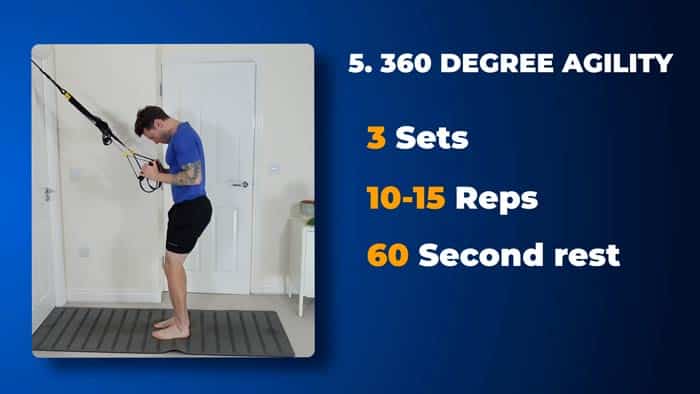
Then to create 360-degree leg agility, do TRX narrow squats.
Go for 3 sets of 10 – 15 reps with a 60 second rest between each set
And here are some FAQs I get asked about leg exercises with a TRX…
FAQ
Are TRX exercises good for bad knees?
They can be. The straps support part of your bodyweight, so you can strengthen your legs without overloading your knees. And with muscle-centric technique, you put the load onto your muscles rather than your joints. If you have a diagnosed injury, check with your doctor or physio first.
Should I squat if I have knee pain?
Usually, yes, but the way you squat matters. Mindlessly moving up and down loads your knee joint. Targeting a specific muscle (pushing your feet outwards in narrow squats, or pulling yourself down with your hamstrings in wide squats) shifts the load onto your muscles. Start with a shallow range that feels comfortable, and go deeper week by week.
Can weak hamstrings cause knee pain?
They can contribute to it. When your quads are much stronger than your hamstrings, the imbalance changes how your knee moves and is loaded. That’s why three of the five exercises in this post focus on the back of your legs: leg extensions, wide squats and hamstring curls.
How often should I do TRX leg exercises with bad knees?
2–3 times a week, with a rest day in between. Focus on slow, controlled reps rather than more volume, and only increase your range of motion or your angle when your knees feel good.
More TRX Guides by Body Part
- TRX Chest Exercises
- TRX Arm Exercises
- TRX Core Exercises
- TRX Back Exercises
- TRX Leg Exercises
- TRX Shoulder Exercises
But here’s the thing…
If you only fix your legs while your upper body stays weak and your core is unstable, you’re like a house with a strong foundation but rotting walls.
Everything will eventually collapse..
That’s why you need to check out my TRX full body workout next, where I’ll show you the 8 exercises that build complete strength, mobility and athleticism from head to toe.
Plus, there’s a free 4-week workout plan that puts them all together, ready for you to download.
Here’s to your Fitness Freedom!
Coach Adam aka TRX Traveller


0 Comments